


This is Part III of our series, “The 21st Century’s Oil: Solving For China’s Rare Earth Dominance.” Today we tackle solutions. If you missed Part I or II, click here. If you like what you’re reading, please share with friends and consider becoming a paid subscriber. Solving For examines one urgent problem at a time—what’s broken, the forces shaping it, and clear, credible solutions. New posts land each Thursday. Learn more.
On a humid May morning in 1978, rebel forces swept into Kolwezi, a mining town in southern Zaire rich with cobalt. Overnight, the world’s top supplier of a metal critical to jet engines, nuclear submarines, and spacecraft went offline. Prices spiked. France and Belgium sent paratroopers to retake the town, backed by U.S. support.
It became known as the Second Shaba War — a “mineral war.” The Cold War loomed in the background, but it wasn’t ideology that set off Western alarm. It was cobalt. The crisis exposed how fragile global supply chains can be — and how quickly a single material can unsettle the world.
Half a world away, Japanese metallurgist Masato Sagawa was paying attention. The strongest magnets of the day used samarium-cobalt alloys — effective but costly and vulnerable to the kind of disruption unfolding in Zaire.
Determined to find a better way, Sagawa turned to iron — abundant and cheap — and paired it with neodymium, a rare earth element with powerful magnetic properties. In 1982, he unveiled the neodymium–iron–boron magnet — stronger, cheaper, and crucially, cobalt-free.
The effect was transformative. His magnet shrank hard drives and powered the personal computing boom. It enabled more efficient cars and wind turbines. Today, it’s inside Ford vehicles, MRI machines, iPhones, missile guidance systems, fighter jets, laptops, and cordless power drills. Four decades on, Sagawa’s breakthrough is still the beating heart of the digital revolution, the energy transition and modern defense.
It also proved something bigger: innovation redraws the map. The metals we rely on aren’t fixed. They’ve shifted before, and they’ll shift again. Solving for China’s rare earth dominance isn’t only about catching up — it may mean inventing something better.
As David Abraham, author of The Elements of Power, put it during a March talk at Boise State University: “Innovative processes can help us not just catch up to China, but to produce something new. And that’s where I think the opportunity is for us.”
The Road Back
In Part Three of our series, we turn to what comes next — the search for solutions.
The problem is clear. Rare earth elements — 17 metals on the periodic table — form the backbone of the modern economy. Yet China controls more than 90 percent of processing and manufacturing — and has shown a willingness to use that dominance as leverage.
To solve the problem, a starting point is defining success. Is it a fully domestic U.S. supply chain, built with billions to expand mining and manufacturing? Equity stakes in overseas projects? Or even buying mineral-rich Greenland, as once floated?
For Abraham, the answer is simpler: “A robust global market so that any company wanting to set up doesn’t have to fear that the resources they need will be cut off.”
That vision is the North Star we’ll adopt here. There’s no single fix. But together, four strategies point the way:
Industrial policy to build capacity at home.
Partnering with allies to diversify supply.
Recycling to reclaim metals already in circulation.
Innovation and talent to create what doesn’t exist yet.
Each matters. History suggests the last — innovation — is what ultimately moves the frontier.
Industrial Policy: Building at Home
The U.S. has long championed free markets. Yet when the stakes are highest, it turns to industrial policy — large-scale public investment that enables private industry to achieve goals in the national interest.
In 1862, in the middle of the Civil War, Abraham Lincoln signed the Pacific Railway Act. Rather than build the railroad itself, the government provided loans and land grants, shifting risk to private companies and making the project profitable. Seven years later, coast-to-coast travel collapsed from six months to a week.
A century later, in 1961, John F. Kennedy’s Apollo pledge did the same. NASA poured billions into contracts with Boeing and others, culminating in Neil Armstrong’s moonwalk — and cascading breakthroughs in aerospace, computing, and engineering.
Semiconductors provide a recent case study. Taiwan’s TSMC produces over 90 percent of the world’s most advanced chips, leaving the U.S. acutely vulnerable if China were to blockade or invade Taiwan. Washington responded with the bipartisan CHIPS and Science Act of 2022, which President Biden signed into law, channeling billions into domestic chipmaking. What started as a single TSMC site in Arizona is now a sprawling campus in Phoenix.
Today’s target: rare earths.
At the center of America’s revival is Mountain Pass, a Mojave Desert mine that once led the world. After bankruptcy in 2015, investors James Litinsky and Michael Rosenthal acquired it, forming MP Materials. Its mission: “restore the full rare earth supply chain to the United States.”
But getting there requires more than capital. It requires industrial policy.
The Biden administration provided more than $100 million in funding. In July, the Trump administration went much further: $400 million from the Department of Defense to expand mining and build a magnet factory; a $150 million loan; and a 10-year guarantee to buy unsold magnets. In return, the Pentagon became MP’s largest shareholder with a 15 percent stake.
“This initiative marks a decisive action by the Trump administration to accelerate American supply chain independence,” said Litinsky, MP Materials’ chairman and CEO.
Still, the move stirred debate. Supporters see it as a bold, necessary jump-start; critics warn it risks favoring one company and stifling competition. “This is the level of intervention you’d normally see in China,” said Gracelin Baskaran, director of the Critical Minerals Security program at CSIS.
Meanwhile, MP Materials isn’t alone. Washington has committed more than $250 million to Lynas Rare Earths of Australia for a Texas processing facility. The broader aim is to spark activity across the supply chain: magnet makers like Vulcan Elements in North Carolina, Noveon in Texas, eVAC Magnetics in South Carolina, and USA Rare Earth in Oklahoma.
Yet standing up a domestic supply chain alone likely won’t close the gap. China’s lead is too vast. Matching it would be enormously expensive — and politically difficult to sustain. Japan’s experience is instructive. After China cut off rare earth shipments in 2010, Tokyo struck deals with Lynas and vowed independence. Fifteen years later, dependence crept back.
“Tokyo found that partially reducing dependence still leaves Beijing with plenty of leverage,” wrote Yoko Kubota in The Wall Street Journal in July. “At the same time, complete independence costs billions of dollars, not millions. After the crisis passed and China resumed exports, the urgency to diversify waned.”
That’s why many argue U.S. industrial policy must fit within a broader international strategy. As Gracelin Baskaran told Congress in May: “While ramping up domestic mining will be crucial, the uncomfortable truth is that the United States cannot solve this crisis alone.”
Allies Matter: Forging Partnerships
The United States isn’t alone in facing China’s rare earth dominance—but no single country can counter it alone. The United States has allies with significant reserves — Brazil, India, Australia — and partners in Europe now expanding their own industries. The question is whether America will lead with them or alienate them.
History offers examples of multilateral efforts formed to meet critical moments. NATO was created in 1949 to counter the Soviet threat. OPEC, formed in 1960, gave oil-producers collective leverage. Both show the strength of coordinated action—whether to deter a rival or shape a market.
That logic applies now. In 2022, the Biden administration launched the Minerals Security Partnership, uniting Australia, Canada, Japan, South Korea, India, the UK, and the EU to coordinate mining and manufacturing. Europe, for its part, has expanded rare earth operations in Estonia and France, discovered a massive new deposit in Sweden, and passed the Critical Raw Materials Act in 2024 to accelerate mining, processing, and recycling.
The Trump administration has taken a different tack: skepticism toward multilateralism, favoring one-off deals and hard-edged leverage. Trump declared that the U.S. would take control of Greenland “one way or another.” He suggested annexing Canada. He pressed Ukraine for a mineral deal while it fights for survival against Russia.
Yet there’s little indication that allies need coercion. “Countries want U.S. investment,” said José Fernandez, a former senior State Department official who helped launch the Minerals Security Partnership.
An assessment earlier this year ranked the countries with the largest rare earth reserves after China. The top three: Brazil, India and Australia.
All three are traditional U.S. partners. Yet tariffs of 50 percent on Brazil and India — and lesser but still meaningful tariffs on Australia — have chilled relations.
“For decades America has stood by its friends and deterred its enemies,” wrote The Economist. “That steadfastness is being thrown upside down, as Donald Trump strong-arms allies and seeks deals with adversaries.”
Whether through the Minerals Security Partnership or another framework, the allies are there — if the U.S. is willing to lead.
Rep. John Moolenaar, a Michigan Republican who chairs the House Select Committee on Strategic Competition between the U.S. and China, declared at a July 23 hearing that the answer is to “build international coalitions that reduce dependency because the next round of coercion won’t wait until we are ready.”
Reclaiming What’s Out There
Unlike oil, rare earths don’t burn away. They can be recovered and reused. Yet for decades, they’ve ended up in landfills, sealed inside discarded electronics. Fewer than 5 percent of magnets in consumer tech gadgets are recycled today.
That’s changing.
Take Marie Perrin, a 29-year-old scientist born in Houston who studied at École Polytechnique in Paris and earned her PhD in chemistry at ETH Zürich. She developed a breakthrough method for extracting europium — vital for LED lighting — from spent fluorescent lamps. In 2023, she launched the startup REEcover to take it to market. This summer, she won the European Young Inventors Prize and the World Builder Jury Prize at a ceremony in Reykjavik.
Rare earth “sourcing by traditional mining poses significant environmental and geopolitical issues,” said Perrin in a video for the awards. “But we have a solution to both of these problems by actually sourcing these metals from the very waste we produce.”
Other breakthroughs are moving from lab to market. Hydrogen processing of magnet scrap, first developed at the University of Birmingham, is being scaled commercially. Firms like Cyclic Materials — with investors including Amazon and Microsoft — are expanding North American recycling capacity. In July, Apple and MP Materials announced a new recycling facility at Mountain Pass; Apple says nearly all magnets across its devices now use 100 percent recycled rare earth elements.
What was once waste is being reimagined as a strategic reserve — and the potential is enormous. A 2024 U.S. International Trade Commission report estimated that by 2050, recycled rare earths could meet up to 70 percent of U.S. clean energy demand.
But obstacles remain: fragmented e-waste systems, products not designed for disassembly, and policy still tilting toward mining. With the right incentives, though, recycling could shift from boutique to backbone.
A Different War Over the Periodic Table
Industrial policy can restart the engine. Alliances can widen the road. Recycling can reclaim what we’ve already mined. But talent and innovation determine the destination.
Ultimately, the race for rare earths won’t be won by subsidies or stockpiles. It will be won by people — the scientists, investors and entrepreneurs who imagine new possibilities.
Yet the U.S. pipeline is dwindling. As the U.S. has revolutionized the world through computer science, it stepped back in materials science.
In 1982, 25 universities offered mining and mineral engineering programs. By 2024, 14 remained. Enrollment has plunged from nearly 1,500 undergraduates in 2015 to 590 in 2023. Bachelor’s degrees awarded annually in the sector have fallen from 371 to 162. In contrast, China has 45 programs that enroll 12,000 students and graduate 3,000 each year, according to Vladislav Kecojevic of the Society of Mining Professors.
The imbalance is stark. Yet the opportunity is, too.
The U.S. has shown that bold public investment can transform research and talent. Vannevar Bush’s wartime mobilization — and his 1945 report Science, the Endless Frontier — launched federal support for university science, driving breakthroughs from radar to the internet. Cold War–era funding through NASA, DARPA, and NSF fueled revolutions in aerospace, computing, and biotech. The same approach could revive materials science today.
And stubborn challenges can be powerful motivators.
It was in a moment of crisis — when cobalt was cut off by conflict — that Masato Sagawa invented the neodymium-iron-boron magnet. His breakthrough eased cobalt risk and reshaped technology for decades. But it also created a new reliance: neodymium, mined and processed overwhelmingly in China. As China rose as a geopolitical rival, yesterday’s solution became today’s vulnerability.
That paradox underscores the challenge before the U.S. The only way out is through people able to imagine new materials, new processes, and new breakthroughs that loosen the grip of dependence.
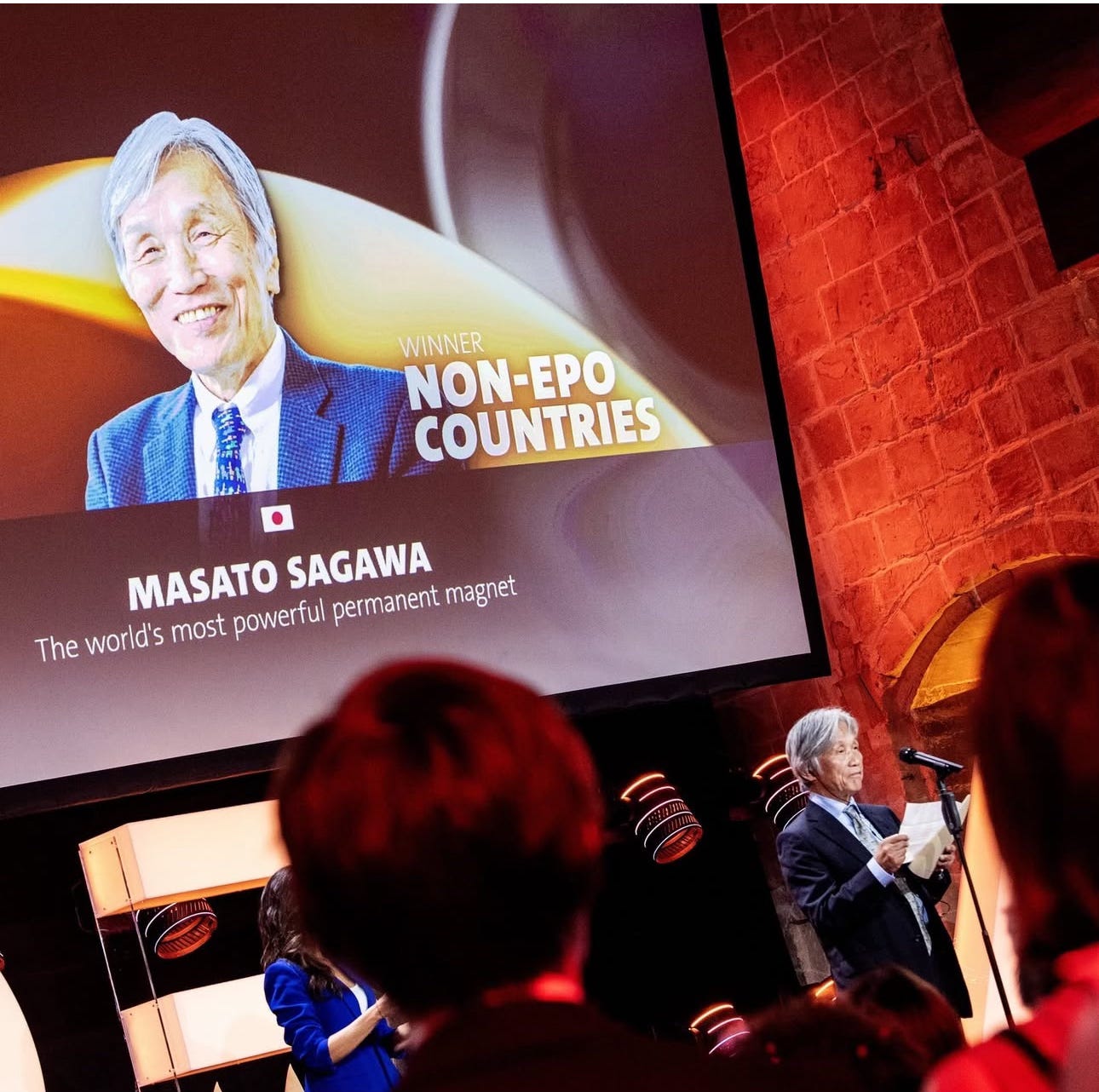
Recognition for such work has been slow. Sagawa himself remains relatively unknown despite his outsized achievement. In 2024, on a summer day in Malta, Sagawa was awarded Europe’s Inventor Prize at a ceremony on the Mediterranean island. The scientist, now 80 years old, took the stage and accepted the award with a slight bow. Turning to the audience, he spoke to the next generation.
“I hope this award will help young people who aspire to become material scientists realize how useful research and development in materials science and technology can be for society,” he said, reading from a sheet of paper, “and that it will serve as an encouragement to them.”
That is the task now: elevate not just coders and founders, but chemists, metallurgists, and engineers. Make careers in materials science as aspirational as software and AI. Inspire the next Sagawa — someone who can turn today’s constraints into tomorrow’s breakthroughs.
Note: Prefer to listen? Use the Article Voiceover at the top of the page, or find all narrated editions in the Listen tab at solvingfor.io.
Series Overview
The 21st Century’s Oil: Solving For China’s Rare Earth Dominance
Part I: The Invisible Backbone, Sept. 4, 2025
The Problem — What’s broken, and why it matters
Part II: The Middle Kingdom’s Monopoly, Sept. 11
The Context — How we got here, and what’s been tried
Part III: The Race to Rebuild, Sept. 18
The Solutions — What’s possible, and who’s leading the way
Great series. But I would add another element to the equation for solving the rare earths crisis: Leadership. Right now, there is a dearth of leadership on the world stage. I could go on and on, but as you work through other issues in future essays, you might eventually consider this one: How to create and motivate leaders in a world which lessens their potential effectiveness. Perhaps it’s a failure of education; perhaps too many outlets for effective discourse; perhaps other factors.