


Solving For tackles one pressing problem at a time — unpacking what’s broken, exploring the forces shaping it, and spotlighting clear, credible solutions. Each series unfolds weekly. Learn more.
Raw materials have long powered the rise of empires.
In the 1500s, Spanish galleons hauled gold and silver from the Americas, bankrolling conquest. In the 1800s, Britain’s coal fueled the Industrial Revolution and turned a small island into the world’s factory. In the 20th century, oil redrew borders and powered America’s rise as a superpower.
Now, in the 21st century, a new set of raw materials sit at the heart of the global economy: seventeen obscure elements on the periodic table, known as rare earth elements.
They’re everywhere — in smartphones, laptops, flat-screen TVs, earbuds, and LED lightbulbs. They’re essential to electric vehicles, advanced batteries, solar panels, and the chips and data centers driving artificial intelligence. And in a volatile world, they underpin military power — embedded in guided missiles, missile defense systems, fighter jets, drones, and warships.
In short, rare earth elements are the invisible backbone of the modern world.
But there’s a problem — a big one.
One country holds a near-monopoly. China controls some 70% of global mining and more than 90% of processing and manufacturing, according to the Financial Times. At any moment, China can cut off access to the elements that are the DNA of the digital age.
Our first Solving For series —The 21st Century’s Oil: Solving For China’s Rare Earth Dominance — explores this looming fault line: China’s near-total control of rare earth elements, and the danger it poses to economies and national security alike.
When Beijing Pulled the Plug
This spring, China showed just how quickly it can weaponize its dominance — cutting off supplies and sending shockwaves from factory floors to defense ministries worldwide.
In April, after President Trump raised tariffs on Chinese goods to 145 percent, Beijing struck back by restricting exports of seven critical rare earths. The impact was swift. Ford idled its Chicago plant after running out of magnets for its Explorer SUV, while several European auto suppliers halted production. Prices spiked — one supplier reportedly paid more than $15 apiece for tiny magnets that normally cost less than 40 cents.
“The Black Swan event has materialized,” Amanda Lacaze, CEO of Australia’s Lynas Rare Earths, among the largest non-China rare earth miners, said at the time.
In June, U.S. and Chinese officials struck only a temporary deal: China agreed to ease restrictions for six months.
By July, in a move to begin shoring up its supply, the U.S. Department of Defense invested $400 million to secure an ownership stake in MP Materials, operator of America’s largest rare earth mine. The package, echoing China’s practice of subsidizing strategic industries, also included a $150 million loan and a decade-long price guarantee that may cost U.S. taxpayers hundreds of millions more.
China brushed off the move. “Our tech advances will consolidate China’s rare earth price-setting power,” Zhang Xigang, CEO of one of China’s two state-owned rare earth giants, declared last month. “International markets will remain dependent on China’s rare earth supply chain for the foreseeable future.”
Gracelin Baskaran, who leads the critical minerals security program at the Center for Strategic and International Studies in Washington, D.C., put it bluntly: rare earths are “one of America’s greatest national and economic security challenges of our time.”
Strategic Stardust: Becoming the DNA of the Modern Economy
Despite their name, rare earths aren’t rare.
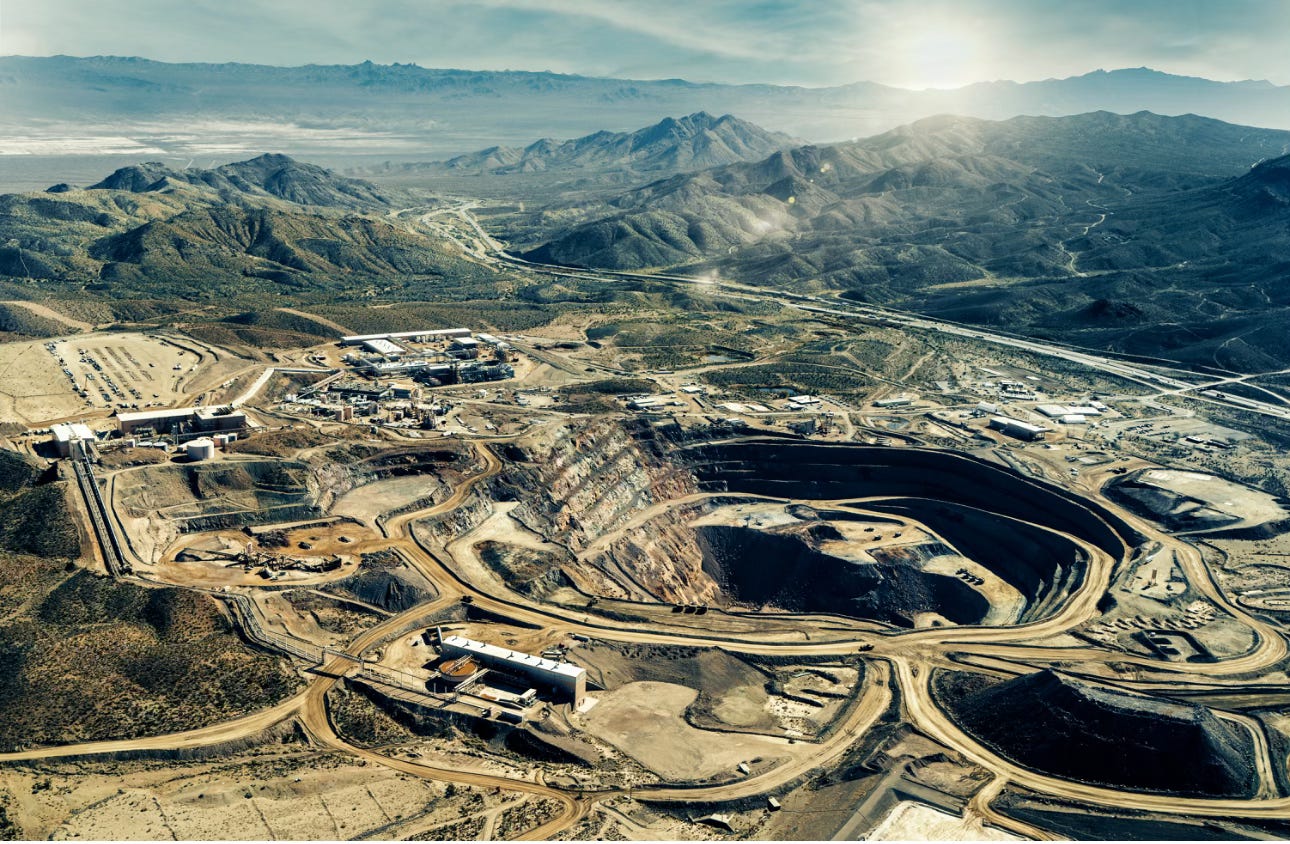
They’re scattered across the Earth’s crust on every continent — from South Africa’s Western Cape scrublands to the jungles of northern Myanmar, from Brazil’s Minas Gerais highlands to the remote outback of Mount Weld in Australia. For decades, the world’s largest rare earth mine was much closer to home: Mountain Pass, in California’s Mojave Desert near the Nevada border.
Yet for most of modern history, rare earths were niche industrial materials rather than an economic force. The first—yttrium—was identified in 1787 at the Ytterby quarry near Stockholm, and over the next two centuries others were isolated. With a few exceptions, they remained peripheral to the broader economy.
That changed in the late 1980s and early 1990s with the rise of consumer electronics.
What makes rare earths special is their ability to do what other materials can’t: produce magnets that are powerful yet lightweight, withstand high temperatures without losing strength, and shrink devices without sacrificing performance. In short, they make modern technology smaller, faster, and more efficient.
Rare earths are rarely used alone or as a primary material. Instead, as David Abraham writes in his book The Elements of Power, they play a role “similar to yeast in pizza.” Even in small doses, rare earths added to a blend of metals such as iron or aluminum, can transform the whole. “While they are only used in small amounts, they’re essential,” he explains. “Without yeast there’s no pizza, and without rare metals there’s no high-tech world.”
It’s a part of the technology revolution story often overlooked. As the computer age gave way to the digital age, it quietly spawned the rare metal age. America celebrated Silicon Valley and the rise of the internet — but overlooked the obscure elements making it all possible.
China didn’t. Instead, it built its dominance in two very different regions.
In the misty, subtropical hills of Jiangxi Province in southeastern China, miners inject acid into red clay to extract rare earths with names like dysprosium and terbium. It’s a place most people have never visited—but nearly everyone has a connection to it.
“Nearly all of your electronics contain specks of metal from those mines,” writes Abraham, whose 2015 book was a prescient account of rare earths’ rising importance in modern life.
Meanwhile, 1,400 miles to the north, on the arid, windswept plains of China’s Inner Mongolia, lies Bayan Obo—the largest rare earth deposit in the world. There, near the industrial city of Baotou, massive excavators tear into open-pit mines, unearthing rock rich in neodymium and praseodymium.
Together, Jiangxi’s clay and Bayan Obo’s ore form the beating heart of the global rare earth supply chain.
More Than Mining
Yet China’s dominance isn’t just about what’s in the ground.
Unlike gold or diamonds, which have value the moment they’re pulled from the earth, rare earths are worthless in raw form. They must be separated, refined, and then manufactured into specialized materials — magnets, phosphors, alloys, powders — before they become useful. It’s a complex, costly, and toxic process that China mastered while others stepped back.
“Rare earths have the maddening characteristic of being relatively common yet incredibly difficult to exploit and amass,” writes University of Delaware Professor Julie Klinger in her book, Rare Earth Frontiers.
Separating rare earths is especially difficult because they’re often found together and share similar properties. Pulling them apart requires advanced expertise, specialized equipment, and chemical-intensive processing. This is where China’s grip tightens: it handles 90 percent of global refining, with few large-scale alternatives elsewhere.
And it doesn’t stop there. After refining, the elements are turned into high-performance components—a stage China also dominates, producing more than 90 percent of the world’s output. Its magnets power EV motors and wind turbines, and sit inside AirPods. Its phosphors light up iPhone displays and flat-screen TVs. Its alloys strengthen jet engines and hybrid car batteries. Its powders polish camera lenses to crystal clarity.
The national security stakes are immense. A single F-35 fighter jet contains more than 900 pounds of rare earths. A U.S. Navy Arleigh Burke-class destroyer carries about 5,200 pounds. A U.S. Virginia-class submarine? Roughly 9,000 pounds, according to CSIS’ Gracelin Baskaran.
Meanwhile, demand is only growing — driven not by one, but three global transformations:
The relentless expansion of consumer tech, from smartphones to wearables.
The transition to sustainable energy, including EVs, wind turbines, and solar panels.
The evolution of warfare, from precision-guided missiles to autonomous drones.
And China hasn’t just built a supply chain—it’s built a moat.
By some estimates, Chinese entities have filed more rare-earth patents than the rest of the world combined. National Defense Magazine reported that China was on track to surpass the rest of the world by 2021 — and its lead has almost certainly grown since. Its refining processes are tightly guarded secrets. And it has built a deep bench of engineers, chemists, and metallurgists in universities and state-backed labs to ensure the expertise stays within its borders.
“China’s dominance is nearly absolute,” wrote Mary Gallagher, Dean of Notre Dame’s Keough School of Global Affairs in June, “from mining and processing them to manufacturing.”
The Wake Up Call
Yet, no one should be surprised.
Fifteen years ago, on a blustery September morning in the East China Sea, Japanese Coast Guard ships spotted a Chinese fishing trawler in disputed waters near the Senkaku Islands – an archipelago claimed by both Japan and China.
As the Japanese Coast Guard pulled up alongside the Chinese vessel, loudspeakers blared: “You are inside Japanese territorial waters. Leave these waters.”
The Chinese boat stayed. Defiantly, the Chinese captain turned his boat toward the Japanese Coast Guard ships and rammed them. Then he rammed them again.
Furious, the Japanese Coast Guard officers boarded the trawler and detained the Chinese captain. China demanded the captain’s release, Japan said no. A diplomatic crisis erupted.
And then—quietly but unmistakably—China responded.
Two weeks later, Japanese trading houses called Japan’s Ministry of Economy, Trade and Industry with a troubling message: Chinese exporters had stopped fulfilling rare earth orders. In a single day, all 32 of China’s rare earth exporters halted shipments to Japan, according to Abraham’s The Elements of Power.
China made no public announcement. But they didn’t need to. The message was clear. Japan released the Chinese ship captain.
For Abraham, then doing a fellowship with the Council on Foreign Relations in Tokyo at Japan’s Ministry of Economy, Trade and Industry, the episode was a revelation. What were these obscure raw materials that held such power?
Witnessing Japan’s rapid capitulation, he would later write, “I saw a new geopolitical trump card.”
It was the world’s first clear warning: rare earths weren’t just the building blocks of modern technology. They were leverage. And China was willing to use it.
“The world is fast becoming as dependent on rare metals as it is on oil,” Abraham warned. “This new struggle will create fissures between those who have access to rare metal resources and those who do not.”
Note: Prefer to listen? Use the Article Voiceover at the top of the page, or find all narrated editions in the Listen tab at solvingfor.io.
Series Overview
The 21st Century’s Oil: Solving For China’s Rare Earth Dominance
Part I: The Invisible Backbone, Sept. 4, 2025
The Problem — What’s broken, and why it matters
Part II: The Middle Kingdom’s Monopoly, Sept. 11
The Context — How we got here, and what’s been tried
Part III: The Race to Rebuild, Sept. 18
The Solutions — What’s possible, and who’s leading the way