



In Part Three of our series on social media’s impact on teen mental health, we turn to solutions. How accountability is being pursued on two fronts at once — through more than a thousand cases working their way through the courts in the opening created by the KGM v. Meta verdict, and through efforts like forty state attorneys general pushing Congress to write a duty of care into law. How Australia raised the minimum age to have a social media account and a growing number of countries are following. How parents, schools, and kids themselves stopped waiting for Washington and went phone-free. And how the question of whether the next generation grows up under different terms is now being answered.
Missed Part One? Go here to unpack the epidemic of depression, anxiety, and, tragically, suicide among a generation of teenagers — and social media’s role in it. Missed Part Two? Go here for how a 1996 law shielded the industry, how the platforms engineered the harm behind that shield, and how lawyers built a legal theory to get around that shield. All series (for reading or listening) are at solvingfor.io.
By the time Jonathan Haidt and Catherine Price walked onto The Daily Show set on the night of February 25, 2026, the cultural movement they had helped build was at its most visible. They were in midtown Manhattan to explain to Desi Lydic and her studio audience what had happened to American childhood — and what was, finally, beginning to happen in response.
Haidt had written The Anxious Generation, the 2024 book that crystallized a global conversation about the effects of smartphones and social media on young people's development. Price was the author of How to Break Up With Your Phone. Together they had written a new book for kids called The Amazing Generation. Haidt was on the show to talk about both — but mostly to talk about what had happened in the nearly two years since The Anxious Generation had landed.
A great deal had happened.
“In the first year, we got 40 US states to put limits on phones,” Haidt told Lydic. “Twenty did it right, phone-free for the whole day. Australia is the first country in the world to raise the age to 16 for social media.” The audience cheered. “And just in the last four weeks, a dozen countries have said they're going to follow. So we are at a global turning point.”
The cultural movement Haidt had helped launch — parents organizing in PTA meetings and statehouses, schools rewriting their phone policies, governments passing laws that would have been unthinkable two years earlier — was, by any measure, ascendant.
Then Lydic asked the question the entire movement had been built around.
"How much of the onus falls on the parent and the teachers," she said, "and how much falls on these tech companies and our leaders to do the right thing?"
Haidt's answer is worth quoting, because everything that follows in this installment is, in one way or another, a response to it.
“In any rational world where you had a consumer product that was used by 95% of all children, that had killed thousands of them, that had gotten to the point where 25% of the girls say that it has damaged their mental health…it would have been sued out of existence or at least made an adult-only product.”
“Of course, we don’t live in that world,” Haidt continued. “We live in a world where wealthy industries can just pay not even that much money to buy huge amounts of influence in Congress and block anything.”
But, he said, the states were acting. The rest of the world was acting too. “I think we're going to win on this eventually, and the companies are going to have to bear some responsibility. Of course, in Los Angeles right now, they're on trial for the first time. They're facing a jury. Thousands of kids are dead and they've never had an answer for it.”
“So I think justice will come,” he concluded.
Twenty-eight days later, it did.
On March 25, 2026, in downtown Los Angeles, the jury in KGM v. Meta et al. found that Meta — owner of Facebook and Instagram — and YouTube had breached a duty of care to the minors who used their products. The verdict was the first of its kind: an American jury had held a major social media company liable, on a product-design theory, for harm to a child.
The legal architecture that had shielded the platforms for nearly thirty years had cracked. The rational world Haidt had described had begun to arrive.
For Part Three, we turn to solutions. Since adolescent depression, loneliness, and suicide began their rise after the smartphone and the always-on social platform reshaped American childhood, the work of finding a fix has been underway. It has broadly coalesced around three approaches.
Fix the product. Hold the platforms accountable for the design of what they sell — through litigation like KGM, through legislation like the Kids Online Safety Act, and through regulation requiring age-appropriate design codes.
Raise the age. Restrict access until children are older. Australia's age-sixteen law took effect in December 2025. A growing number of countries are following.
Change what’s normal. Cultural change among parents, schools, and kids themselves. Phone-free school days. Parents organizing in PTA meetings to break the collective action trap that keeps individual families from saying no. Norms about when children get smartphones and when they get social media. Helping kids make their own good decisions.
“This all makes so much more sense if you stop focusing on the phones and you focus instead on childhood,” Haidt said on The Daily Show. “What is a healthy human childhood?”

Fix The Product
The most direct response to the harms documented in this series is the one the KGM jury delivered: hold the platforms accountable for the design choices that caused the harm. This is the project of taking that verdict and making it the rule rather than the exception.
There are two ways to do this: civil litigation and legislation.
Civil litigation rests on a single legal doctrine: duty of care. It's the long-standing principle that anyone who designs and sells a consumer product owes its users a basic obligation not to design it in ways that foreseeably injure them.
For thirty years, platforms operated outside this framework, because Section 230 was read to immunize them from claims arising out of the content their users posted. The KGM verdict did not overturn Section 230. It established something narrower but consequential: that design-defect claims targeting the platform’s own conduct — its recommender systems, its notification engineering, its retention features — survive Section 230 because they are not about user content. They are about the product.
The path applies duty of care case by case. The cases are piling up. Behind the KGM jury verdict sits a docket that increasingly resembles the early years of tobacco litigation: more than a thousand personal injury cases against Meta, YouTube, Snap, and TikTok consolidated in California state court, and more than two thousand coordinated in federal court.
The social media companies have begun settling some cases and fighting others, the same posture Big Tobacco took in the early 1990s before the cumulative weight of verdicts and disclosures produced the 1998 Master Settlement Agreement. Whether the same arc holds for social media remains an open question. What is clear is that the legal wall that protected the industry for thirty years has cracked, and the litigation is moving through the opening.
Legislation takes a different route: write the duty of care into statute. This approach is illustrated by the proposed Kids Online Safety Act, which would set the standard in federal law and let the Federal Trade Commission and state attorneys general enforce it across the industry. KOSA passed the Senate 91-3 in July 2024. The House version, advanced by Republican leadership, stripped the duty of care entirely. Forty state attorneys general wrote in February 2026 backing the Senate version, but the legislation is stuck.
In the absence of federal action, states have moved. Age-appropriate design codes have been enacted in California, Maryland, Nebraska, Vermont, and South Carolina, imposing requirements like privacy by default, no targeted advertising to minors, and a ban on dark patterns such as infinite scroll, autoplay, and streak counters.
Several of these laws are now under First Amendment challenge. In NetChoice v. Bonta, the Ninth Circuit affirmed a preliminary injunction against parts of California's law. Civil liberties groups argue that a duty of care covering the content kids see — not just how the platform is built — chills lawful speech, particularly speech about mental health, sexual orientation, and reproductive care that vulnerable teens often most need to find.
But even if every mechanism outlined here succeeded — if KOSA passed with the duty intact, if the design codes survived constitutional challenge, if KGM became the leading edge of a thousand similar verdicts — the question of whether children should be encountering these products at all would remain.
Fixing the product makes the product safer. It does not answer when, or whether, a child should be using it.
Raise The Age
The second approach starts from a different premise: until the product is safer, keep children away from it.
Australia’s age-sixteen law took effect on December 10, 2025. It applies to Facebook, Instagram, TikTok, Snapchat, YouTube, and X — the platforms most American teenagers use, the platforms named in the KGM litigation, the platforms a generation of parents has watched their children disappear into. Within the first six weeks Australia’s eSafety Commissioner reported that 4.7 million accounts belonging to under-sixteens had been removed, with non-compliant platforms facing fines of up to AUD$49.5 million. Greece has announced that a ban at 15 will start in 2027. France is debating a similar law. Indonesia, Brazil, Austria, Denmark, Malaysia, Ecuador, and others have moved or are moving in the same direction.
The cultural and political logic is straightforward. Individual families could not keep their children off the platforms because the platforms were where their children’s friends were — the collective action trap that Haidt and others have spent two years documenting. A government restriction breaks the trap by making the platform legally inaccessible to everyone at once.
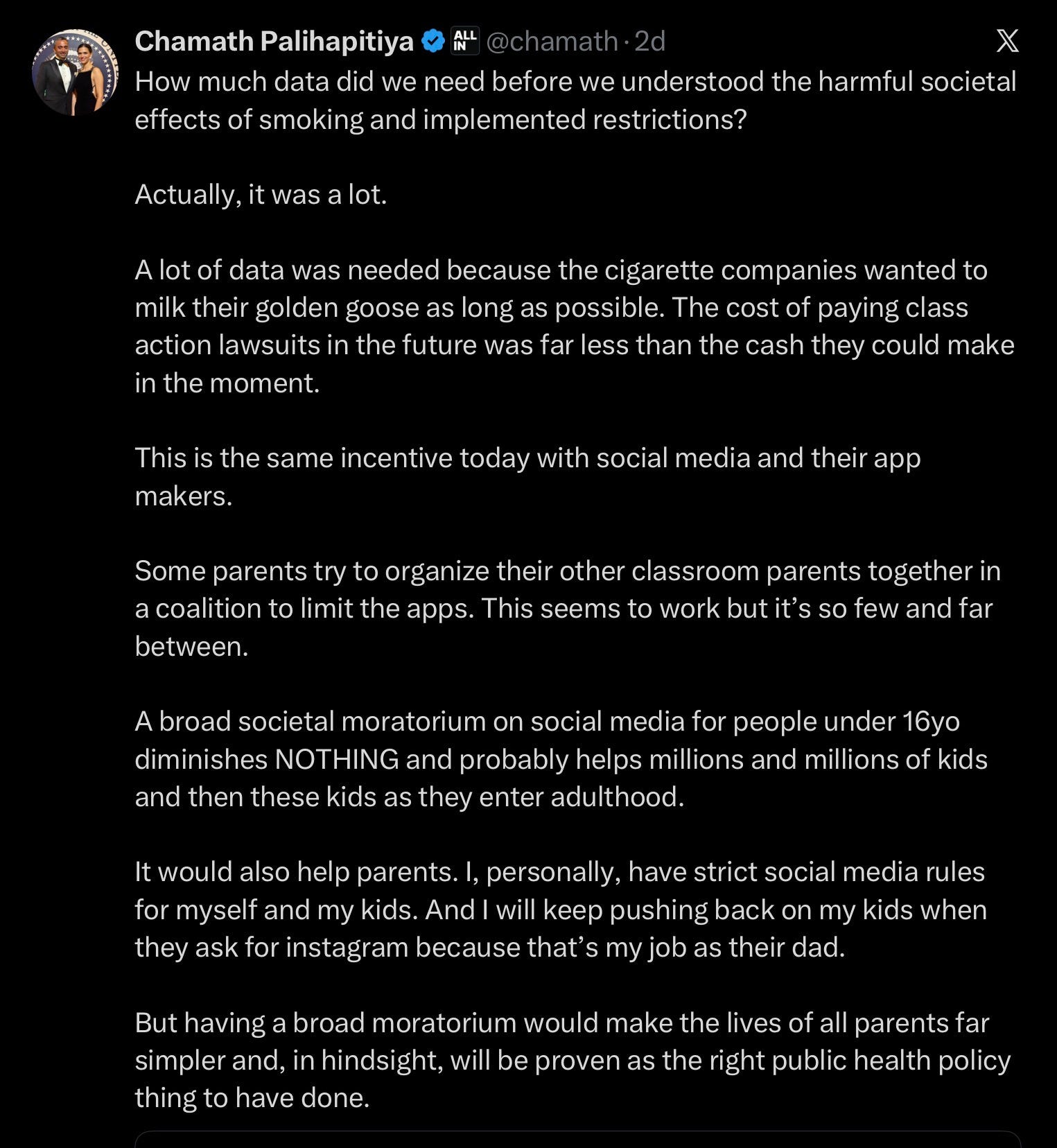
On this question, at a time of deep political polarization in the U.S., the usual partisan map is not holding. Congress has not moved, but states have, and the alignments are unfamiliar. Republican and Democratic attorneys general have filed the same suits. Red-state governors and blue-state senators have backed the same restrictions. Florida’s Republican Governor Ron DeSantis, who signed a law banning Floridians under 14 from holding social media accounts, said, “Being buried in those devices all day is not the best way to grow up.” Connecticut’s Democratic Senator Richard Blumenthal is the lead sponsor of KOSA.
The opposition is bipartisan too: the ACLU on speech and privacy grounds, libertarian conservatives on parental rights. When neither coalition maps onto the usual axis, it may signal something is about to give.
It is too early to tell whether age restriction reduces the harms it targets. Australia’s law has been in effect for less than six months. Public health interventions of this kind take a decade or more to show up clearly in outcome data. What the early reports do show is that the law is not yet reaching the kids it's meant to protect: by March 2026, the eSafety Commissioner found no measurable decline in reported cyberbullying or image-based abuse, and roughly 70 percent of parents whose children had previously held accounts believed their children still did.
The deeper questions are about the framework itself. Candice Odgers at UC Irvine and Amy Orben at Cambridge have long argued that the causal evidence linking social media to youth mental health decline is weaker than the Haidt framework presents, raising doubts about whether interventions built on separating teens from social media will deliver the outcomes proponents promise.
But the case for raising the age does not depend on age restriction being sufficient on its own. It buys time during the years when adolescent brains are still forming. It breaks the collective action trap from above, in a way no individual family can break it from below.
Raising the age does not fix the product, and it does nothing for the older teenagers already on the platforms. But it changes the terms on which the next generation encounters them.
Change What’s Normal
The third approach starts from a different question. Even if every mechanism in the first two approaches succeeded — accountability forcing the products to be safer, every age line raised — children will still encounter them. The question is what kind of children encounter them, and what tools they bring to the encounter.
This is the work of cultural change. It is the work parents, schools, and kids themselves can do without waiting for Congress, the courts, or any government at all. It moves at the speed of families talking to other families, of school boards or a single school principal rewriting their phone policies, of friend groups deciding together what they will and will not do. It does not require legal force.
The most widely adopted intervention is the phone-free school day. By early 2026, 35 states had enacted or recommended classroom phone restrictions, and many districts and individual schools had moved on their own ahead of state action. The early data is encouraging: a study of Florida's statewide ban found rising test scores and falling discipline problems by the second year. At one Louisville high school, library checkouts jumped 61 percent after phones came out of the classroom, and the library became, in the principal's words, a place where students "look at each other in the eyes and talk." At Portland's Grant High School, the principal noticed something simpler after his school went phone-free: lunchtime, he said, was loud again.
Alongside this sit broader efforts: Wait Until 8th, which asks parents to delay giving their children smartphones until at least eighth grade, and similar pledges that let parents act in coordinated cohorts rather than as isolated families. There is also a growing body of writing aimed at kids and teens themselves, including Catherine Price and Jonathan Haidt's The Amazing Generation, which is framed as an invitation rather than a prohibition.
Students are taking matters into their own hands. Student-led efforts like the Reconnect Movement, which creates phone-free social spaces without asking participants to give up phones entirely, have been spreading on high school and college campuses.
Whether phone-free schools and parent pledges reduce adolescent depression and anxiety at the population level is not yet known, and cannot yet be known. The phone-free school day movement is barely two years old at scale.
But the cultural-change approach does something the other two cannot. It does not protect children from a world that includes these platforms; it prepares children for that world. Phone-free school days are not just restrictions — they are practice in what attention without a phone feels like. Parent pledges are not just delays — they are demonstrations of what coordinated adult judgment looks like. The youth movement Haidt and Price describe is more than refusal — it is kids exercising the judgment they will need for the rest of their lives.
The goal is not a smaller world for children. It is the capacity to live in this one.
The Work Has Begun
What is a healthy human childhood?
The harms documented in this series did not arrive overnight, and the answer to them will not arrive overnight either. The tobacco settlement took decades to assemble. The leaded-gasoline ban took a generation. Public smoking bans came long after the science was settled. Industrial harm to children, once it has been built into a profitable consumer product, does not unwind on a political news cycle.
The lesson of the years since Section 230 became law is that this is not a decision the tech companies will make for us. The hands-off posture — Section 230’s shield, the deference to innovation, the assumption that tech leaders would act in the public interest — has been tested at scale and failed. The warnings came from inside the companies themselves — Meta, in particular: the Haugen disclosures, the Béjar testimony, the internal documents now part of the KGM trial record. The leadership chose not to act. A generation of children paid the price.
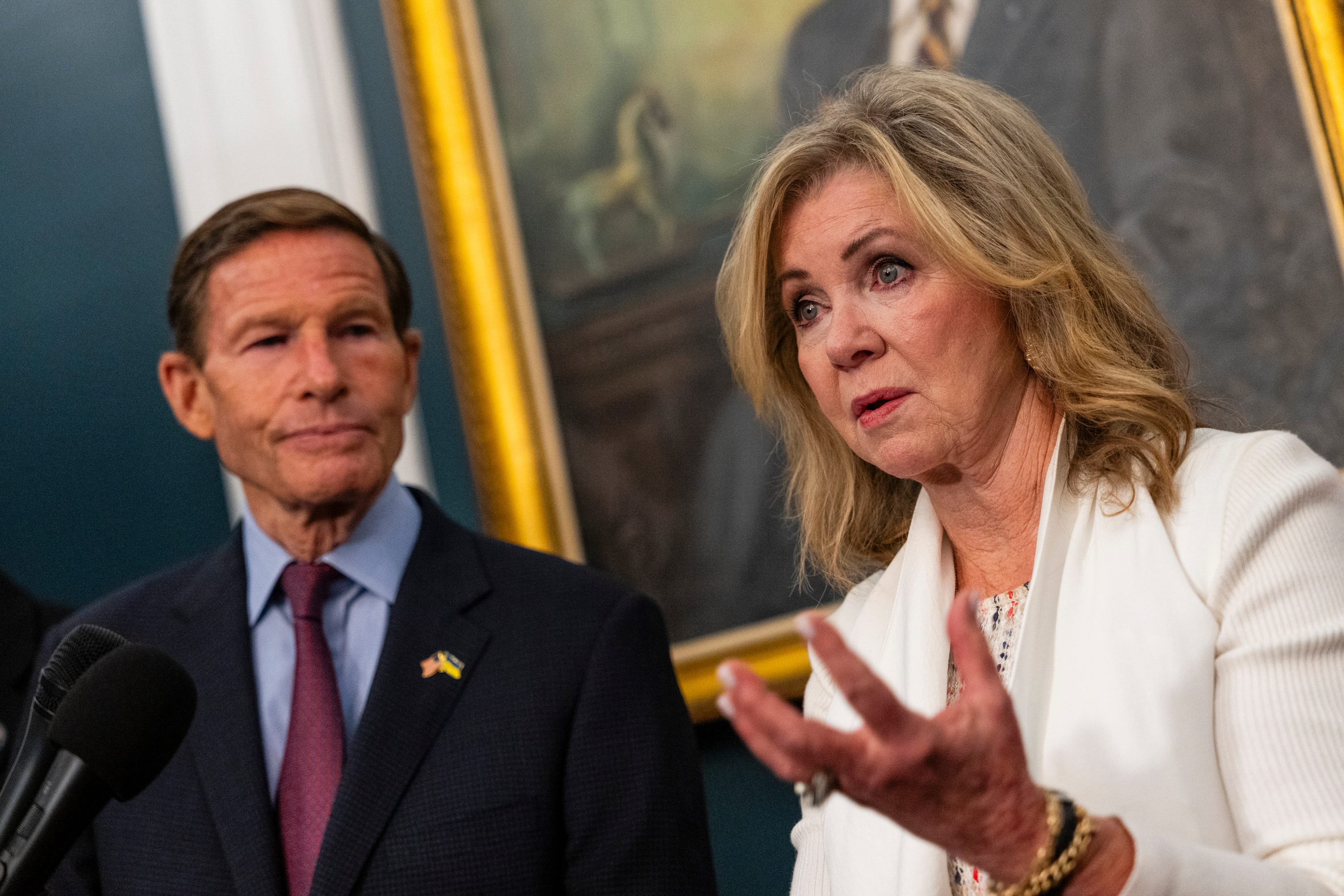
The decision cannot be left to tech companies. The public has to make it. We have to make it.
What can be said now, in the spring of 2026, is that the work has begun. A generation of parents, teachers, and kids themselves stopped accepting that this was normal. The KGM verdict in Los Angeles cracked the legal architecture. Australia raised the age. More than thirty U.S. states have enacted or recommended classroom phone restrictions. Students started organizing phone-free spaces of their own. None of these alone closes the gap between the harm Haidt and Price named on The Daily Show in February and the product still operating today. But the work of closing it has begun.
A generation of children was harmed by design. Whether the next generation grows up under different terms is the question now being answered.
Note: Prefer to listen? Use the Article Voiceover at the top of the page, or find all narrated editions in the Listen tab at solvingfor.io.
Solving For is a deep-dive series that takes on one pressing problem at a time: what’s broken, what’s driving it, and what a path forward might look like.
Previous series have examined rare earth dominance, AI safety, the decline of local news, the end of amateurism in college sports, shrinking competition in Congress, and a world rearming as the global rules-based order weakens. Learn more at solvingfor.io.