


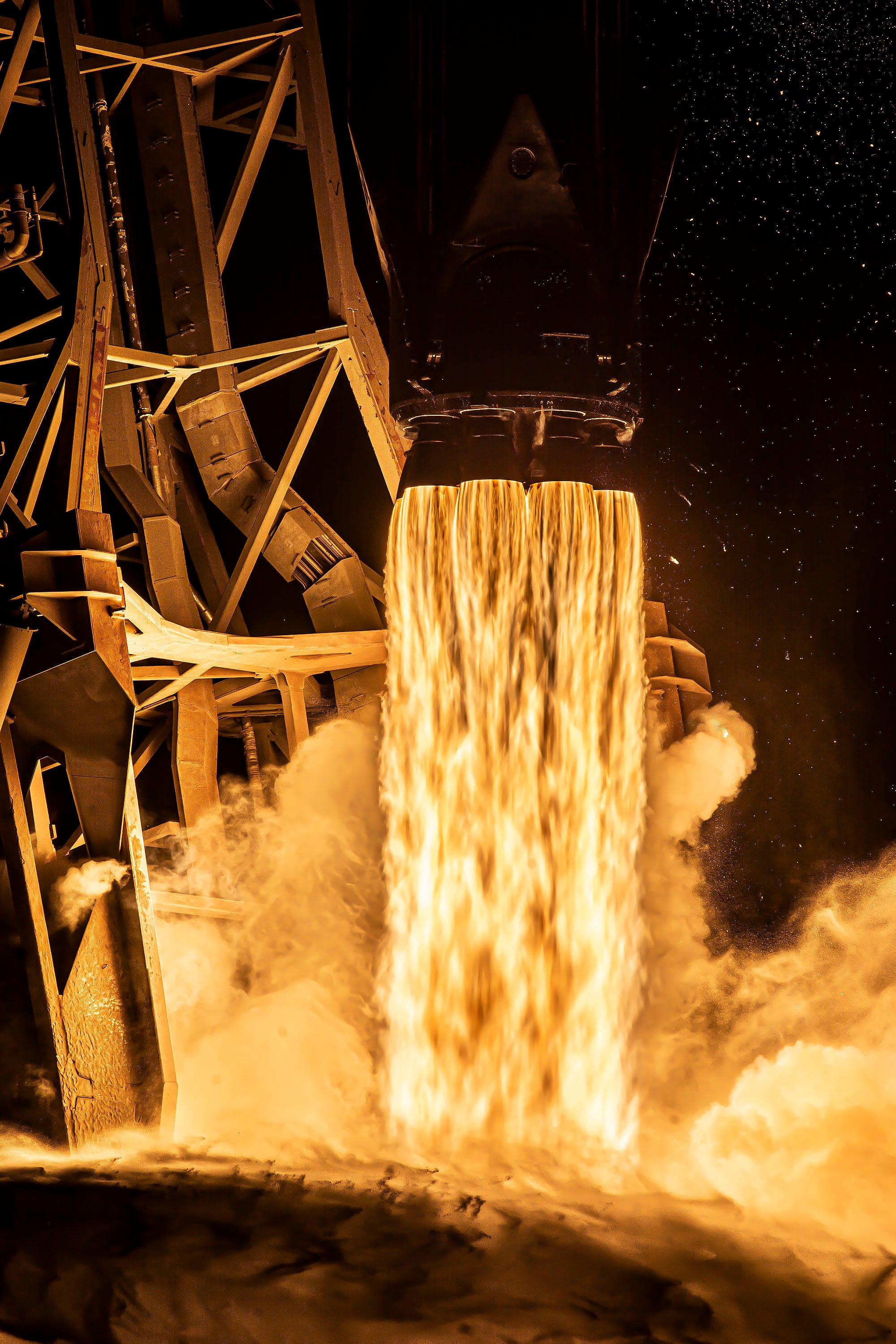
This is part two in our three-part series on space. We explore how the modern commercial space age came to be — both the context and forces driving toward the creation, quite literally, of a highway to the heavens. If you missed it, here’s part one.
Solving For takes on one hard problem at a time — unpacking the stakes, exploring the forces behind it, and surfacing real paths forward. Each series unfolds in weekly installments. You can read or listen to each series — narrated by me — at solvingfor.io, or click the article voiceover at the top of this page.
In 2008 SpaceX proved that a private company could put a rocket into orbit. Then, across three consecutive years, from 2015 through 2017, it proved that a rocket could be brought back to Earth and flown again.
The first was a proof of concept. The next three, taken together, amounted to the hinge moment that brought today’s commercial space age.
SpaceX’s 2008 launch from a remote outpost in the Marshall Islands was a watershed. After three failed attempts, Falcon 1 reached orbit, showing that launching rockets wasn’t just the domain of governments and their traditional contractors. Entrepreneurs and engineers could do it too.
But the breakthrough that best explains the present — when we see multiple launches in a week, thousands of satellites overhead, a private operator landing a spacecraft on the Moon, and credible ambitions for a lasting foothold on the Moon and, eventually, Mars — started with a booster rocket falling out of the night sky.
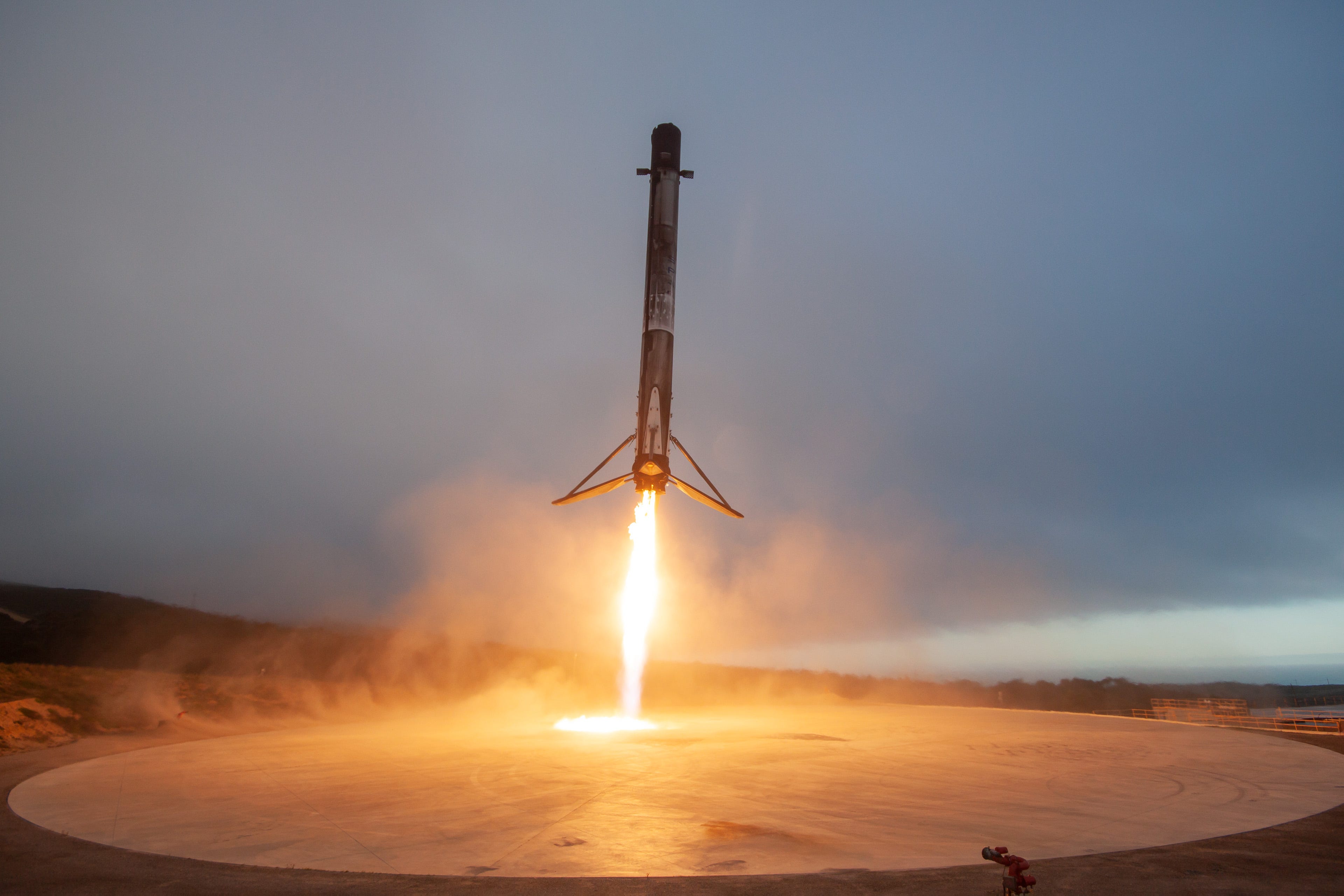
It was on December 21, 2015 that a SpaceX Falcon 9 lifted off from Cape Canaveral carrying 11 satellites into orbit. Minutes into its flight, the booster rocket separated and began falling back toward Earth. But instead of crashing into the ocean, it reignited its engines, slowed its descent, and touched down upright a few miles from where it had lifted off. (See the video.)
It was the first time an orbital-class rocket had ever landed intact.
It was a big deal. A booster rocket accounts for up to 70 percent of the cost of an entire rocket. If it could be reused, the arithmetic of reaching space would change dramatically.
But landing was only the first step. Next came an even harder mission: landing a rocket on a barge at sea, which is critical for boosters with too little fuel to return to the launch site, and then fly it again.
On April 8, 2016, a Falcon 9 delivering supplies to the International Space Station sent its booster descending toward Earth. The booster touched down, landing upright, on a 170-by-300 foot barge called “Of course I Still Love You,” nearly 200 miles off the Florida coast. (See the video.) The name comes from an Iain M. Banks science fiction novel.
Then, on March 30, 2017, the final piece of the puzzle: the same booster that had landed on the barge the year before was launched again, this time carrying a communications satellite into space. (See the video.) Once again, the booster rocket landed upright on the “Of course I Still Love you” barge.
Land a booster rocket. Recover it. Fly it again.
Reusability had been unlocked, and the cost of going to space was about to drop dramatically.
We Chose To Go
This feat, of course, stood on the shoulders of nearly sixty years of the U.S. space program. NASA was started in 1958, a year after the Soviet Union shocked the world by putting the first satellite — Sputnik — into orbit. To the U.S. this wasn’t a scientific achievement; it was a warning shot.
First came NASA’s Mercury program, then Gemini. John Glenn orbited Earth three times in February 1962. Three years later astronauts were docking spacecraft and walking in space. In between, John F. Kennedy stood at Rice University and gave the program its purpose: “We choose to go to the moon in this decade and do the other things,” he declared, “not because they are easy, but because they are hard.”
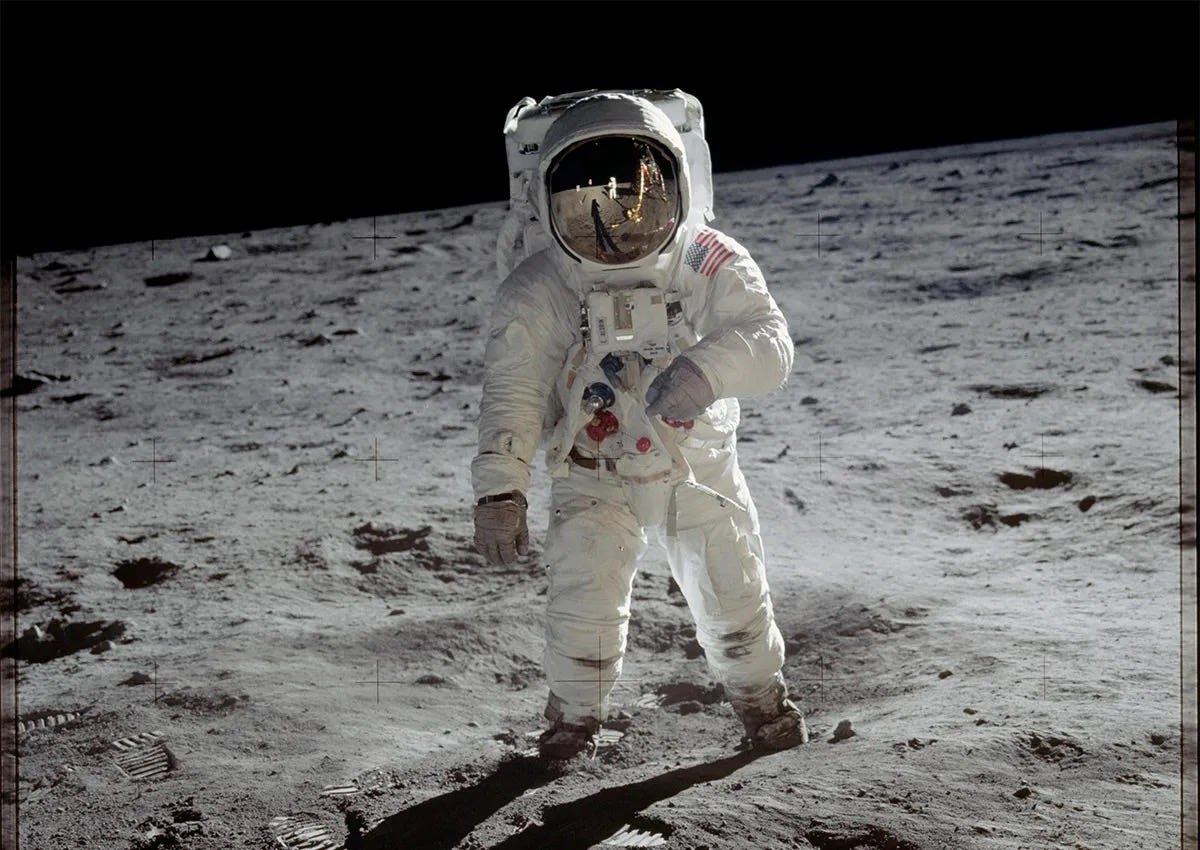
Then came the Apollo program. From July 1969 to December 1972, the U.S. made six successful landings on the moon, resulting in 12 astronauts walking on the lunar surface.
It began with Neil Armstrong stepping onto the moon’s Sea of Tranquility on July 20, 1969. It ended with humanity’s longest stay on the moon to date. Eugene Cernan and Harrison Schmitt spent three days on the moon, driving a rover through the moon’s Taurus-Littrow Valley, venturing miles away from their spacecraft on the rocky lunar landscape, and collecting the largest haul of lunar samples any crew has ever brought home.
When Cernan climbed the ladder on December 14, 1972 to fly home, he became the last human to stand on the Moon.
Each of the missions had one funder and one customer — the U.S. government — and essentially one goal: to beat the Soviets and do it in a public way for the world to see.
The program built the ability to go to the moon seemingly whenever it wished — the only blemish on a trip to the Moon being when the Apollo 13 mission had to abort; astronaut James Lovell famously guided the troubled spacecraft back to Earth.
Yet, after achieving six moon landings in three and a half years, the U.S. lost interest. The final three planned Apollo missions were canceled. People had moved on. No human has set foot on the Moon again.
Stubborn Costs
The Space Shuttle program would come soon after and it was supposed to fix the Apollo program’s biggest flaw: namely, the high costs. The Saturn V rocket, which took astronauts to the moon, had a payload cost of about $5,400 a kilogram to reach orbit, according to a Center for Strategic and International Studies report. NASA originally pitched the Shuttle as something that would be much cheaper.
The Space Shuttle program flew 135 missions, conducted cutting-edge science in orbit, and built the largest structure in space, the International Space Station. But instead of costs going down, they went up — a lot. When the program’s full costs were tallied, the real number came out to roughly $65,400 a kilogram, a dramatically higher cost than the rockets it was meant to replace.
NASA and its longtime contractors — Lockheed Martin, Rockwell International, McDonnell Douglas — didn’t break the costly cycle. By the mid-2010s, the inflation adjusted cost for payloads to low Earth orbit was about $13,600 a kilogram, better than the space shuttle but worse than the days of the Apollo program.
These high costs are why so many of the things explored in Part 1 didn’t exist. A satellite constellation that needs thousands of launches was prohibitively expensive. So was a data center in orbit, or manufacturing pharmaceuticals in microgravity.
Space stayed where it had been: a government project that did much for science, defense and prestige, but not a place to run a business.
Breaking the Cycle
SpaceX’s successful launch in 2008 showed what was possible by putting a privately-funded, lower cost rocket into orbit. And from 2015 through 2017, it showed this could be done at scale by reusing the most costly part of a rocket, the booster.
But it needed to break the high costs that made going to space prohibitive for even most governments. Broadly speaking, SpaceX did it by doing three things.
One, first principles and vertical integration. Rather than buying parts from a supplier, Musk explored what raw materials are needed to build a part and how much it would cost, versus the price of a manufactured part. He called this the “idiot index.” For instance, if a metal bracket costs $1,000 but the raw aluminum costs only $100, the idiot index is ten. When that number was especially high, he would build it from scratch. In time, he created the capability at SpaceX to build many rocket parts in-house.
Two, rapid iteration and failure. In 2012 and 2013 SpaceX began testing a rocket called the Grasshopper that would climb thousands of feet into the air and come back down, landing upright. Each test flight climbed a little higher than the last. Eventually came attempts at landing on floating barges. The more ambitious the test, the more frequent the crashes. (Watch a SpaceX crash video.) But the learnings came just as fast. By 2017 complete success was achieved.
Third, the now-famous process that Musk calls: “the Algorithm.” This is the five step process used at both SpaceX and Tesla:
Make requirements less dumb. Each requirement should come with the name of the person who made it. Each requirement should be questioned, no matter who made it.
Delete the part or process step. Aggressively edit out steps in any process. A report by SpaceX investor Andreessen Horowitz noted that if you do not end up adding back to at least 10 percent of what you deleted, “you did not delete enough.”
Simplify and optimize. This comes after step two because you don’t want to simplify or optimize a step that shouldn’t have existed in the first place.
Accelerate. After doing the first three, find ways to speed things up.
Automate. With everything in place and the bugs shaken out, automate everything that’s repeatable. Many organizations move to this step without the first four.
The result is that SpaceX cut the cost of launching a rocket into orbit by more than 95 percent, as compared to the Space Shuttle, according to the CSIS report. The payload cost went from $65,400 a kilogram in the Space Shuttle era to around $2,600 a kilogram on SpaceX’s Falcon 9 rocket. And for its Falcon Heavy booster launching massive payloads into orbit, the cost is $1,500 a kilogram.
Not Alone
Of course, it’s tempting to view this solely as a story of entrepreneurs disrupting a calcified system. But it’s important to note that SpaceX wouldn’t be the company it is today without NASA. The reason: NASA funded SpaceX.
One example: in 2008, months after SpaceX put its first rocket into orbit, NASA awarded the company a $1.6 billion contract to send rockets to the International Space Station on resupply missions.
“NASA, and specifically the initial commercial cargo contract, is what saved the company when it was on the brink of bankruptcy,” Chris Quilty, who leads a space-focused research firm, told CNBC in 2025.
With such contracts keeping it in business, SpaceX was able to drive down costs so it became a preferred launch provider for anyone wanting to put anything in space. In 2025, SpaceX conducted 165 orbital launches, more than the rest of the world’s launch providers combined, plus five additional test flights with its newer rocket, Starship. (SpaceX has a total of 706 orbital launches as of August 13, 2026; and is growing at a pace of two or more a week.)
And now, with costs much lower, SpaceX is building additional businesses on top of its launch business. In 2019 it began launching its own satellites, called Starlink, into space to offer internet around the world. That business now has some 10,200 broadband satellites orbiting Earth and more than 12 million subscribers in 167 countries, according to its most recent earnings report. And, it hopes, to soon put its own AI data centers, called Starmind, into space too.
Meanwhile, even as SpaceX has become so dominant, it’s not alone in opening access to space.
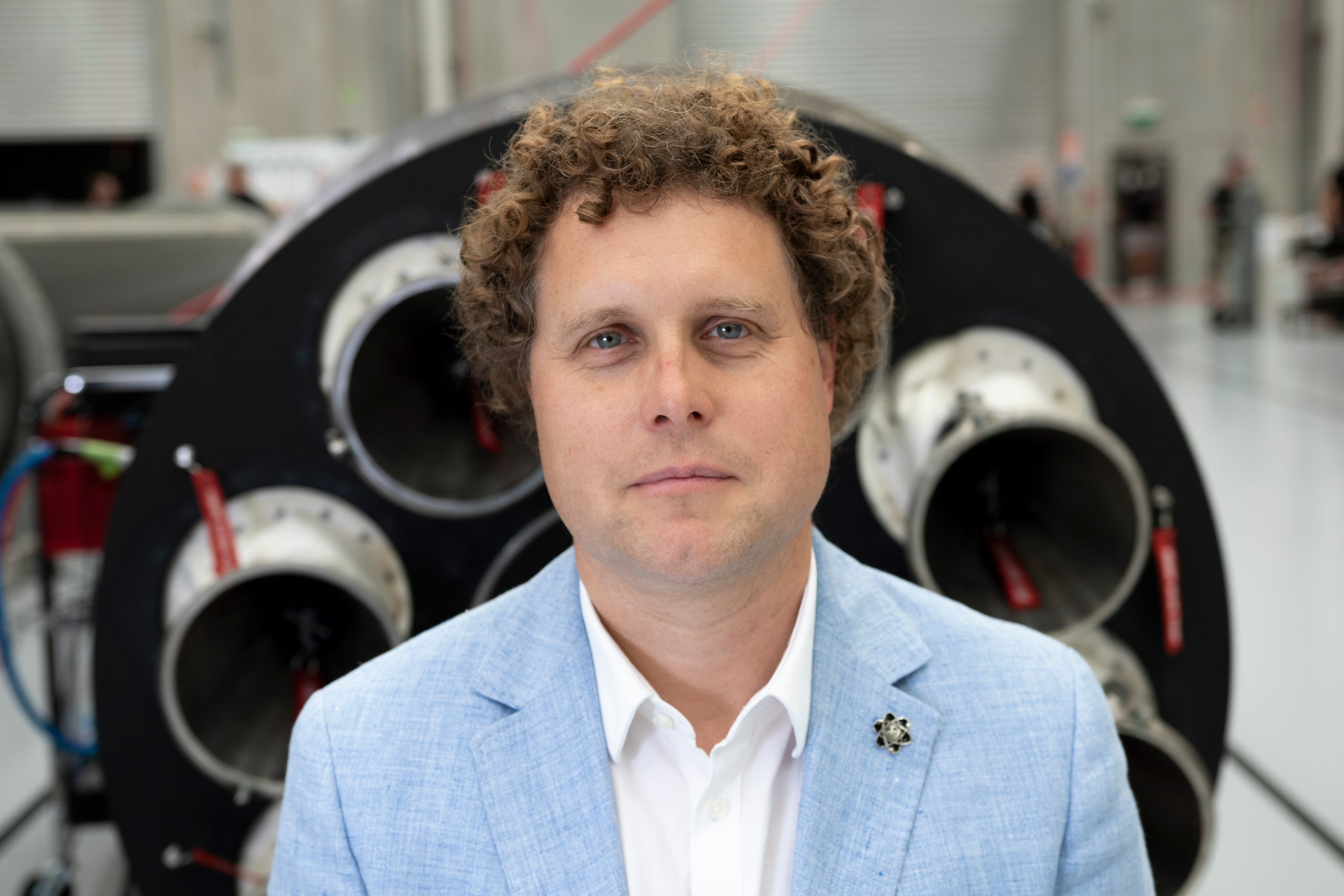
Exhibit A is Rocket Lab, a company founded in New Zealand by a self-taught engineer named Peter Beck. The company put a rocket into orbit in 2018. Its rocket, called Electron, targets the small-satellite market (as opposed to SpaceX carrying bigger payloads) and has become the most flown small launch vehicle in the world. To date, it’s had more than 90 successful missions to orbit.
The likes of Astra and Firefly Aerospace are in the rocket launch business as well, with Astra putting two rockets into orbit and Firefly putting three into orbit successfully. In March 2025 Firefly did the feat of putting a lunar lander on the Moon.
Meanwhile, SpaceX took another step reusing rockets faster and more cheaply. On Oct. 13, 2024 it caught its Super Heavy booster — which powers its new Starship rocket — out of the air. Instead of landing on land or a barge, it was caught by two mechanical arms — called “chopsticks” — on the launch tower itself. (See video below.) With this, there is no towing a booster back from sea or trucking it from a landing pad. It returns to the tower that it launched from, ready to be inspected and flown again.
It’s the same idea that started with the Falcon 9 in 2015 — land it, recover it, fly it again — but pushed one step further by catching it before it even touches the ground.
Ultimately, the plan is spaceflight that’s not dramatically different from commercial aviation. In SpaceX’s case that means going from twice a week to daily — or more. In February, Musk put a number to it, writing on X: “it will get really nutty when Starship is launching every hour in 3 years.”
The highway to the heavens is quite literally being built. The question is what to do with it — and what could go wrong. That’s next.
Prefer to listen? I narrate each edition myself. Scroll up to find the audio version at the top of this page.
Previous Series —
China’s Rare Earth Dominance | AI Safety | Decline of Local News | End of Amateurism in College Sports | Shrinking Competition in Congress | Social Media and Teen Mental Health | A World Rearming as the Global Rules-Based Order Weakens | America’s National Debt Crisis | Reinventing the American Dream
Solving For takes on one hard problem at a time — unpacking the stakes, exploring the forces behind it, and surfacing real paths forward. Each series unfolds in weekly installments. Learn more.