


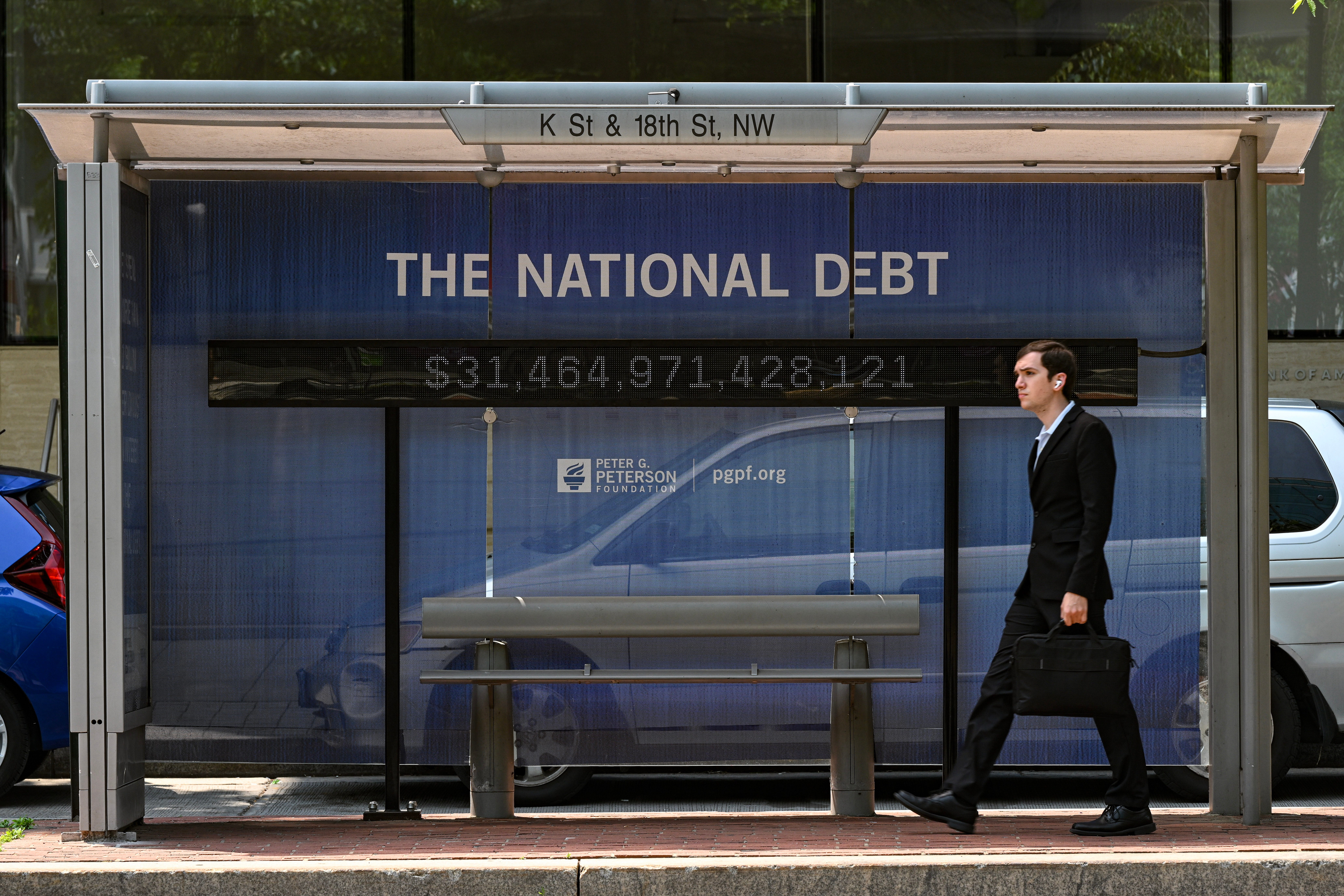
In Part Three — the final installment of our series on the national debt — we turn to solutions. How one economist’s warnings are growing harder to ignore. How seven leading think tanks, spanning the ideological spectrum, each produced a credible plan to stabilize the debt. How a Canadian near-collapse in 1995 offers a preview of what may force Washington to act. And why the window for gradual, humane reform keeps closing with every year Congress defers the hard choices.
Missed the earlier installments? Part One explores why the national debt — now larger than the entire U.S. economy — should matter to every American, and why the generation now entering the workforce is the first to inherit a bill they never agreed to run up. Go here. Part Two examines the forces that built it — politicians committing to investments they were unwilling to pay for, shifting the tax burden away from wealth and toward work, and the Baby Boomers whose retirements created a structural deficit no single Congress has been willing to fix. Go here.
Prefer to listen? I narrate each edition myself. Find the audio at the top of this page or under the Listen tab at solvingfor.io.
Jessica Riedl has spent more than two decades doing math that almost no one in Washington wants to see.
She began her career at the Heritage Foundation in 2001, one of the country’s most influential conservative think tanks, analyzing federal spending, deficits, and debt. She later served six years as chief economist to Senator Rob Portman of Ohio, a Republican known for taking fiscal policy seriously in a party that increasingly did not. Today she is a fellow at the Brookings Institution, after eight years at the Manhattan Institute, still following the numbers wherever they lead.
What makes Riedl unusual in Washington is that her conclusions have remained remarkably consistent regardless of political fashion. She has worked in conservative institutions and center-left ones. She has advised Republicans and collaborated with Democrats. Yet her central message has changed very little.
To Riedl, there is no painless solution to America’s outsized national debt.
The gap between what the federal government has promised to spend and what it collects in revenue has grown too large for any single policy to close. It requires a mix across the fault lines of modern U.S. politics: slower growth in Social Security spending, slower growth in Medicare and healthcare spending, less spending across other federal programs, and higher taxes. None of those changes would happen overnight. All would need to be phased in gradually over many years so households, businesses, and retirees could adjust.
The source of the problem is well understood. Americans are living longer, Baby Boomers are retiring, healthcare costs continue to rise, and elected officials have repeatedly chosen borrowing over taxes or spending cuts. Together, those forces have pushed the national debt to 100 percent of GDP — a level the United States has not seen since the years immediately following World War II. The Congressional Budget Office projects the debt will surpass that postwar record this decade.
Riedl also attacks what she considers budget myths.
Waste, fraud, and abuse are worth addressing, she argues, but the savings are too small to close a fiscal gap measured in trillions. Taxing billionaires more heavily would help, but is not enough by itself. Eliminating foreign aid, shrinking federal bureaucracies, or relying on faster growth may improve the margins, but none fundamentally changes the trajectory.
Riedl has been direct about where that trajectory leads. Unless reforms are enacted, she has written, Washington's escalating borrowing demands will eventually overwhelm the capacity of financial markets to supply lending at plausible interest rates. When that happens, interest rates soar and the federal government cannot pay its bills. The effects would not be abstract — mortgage payments would climb, retirement accounts would lose value, and businesses would pull back on hiring and investment.
In a 2024 interview on PBS’s Firing Line, Riedl noted that when she meets privately with Republicans and Democrats, lawmakers often agree on the broad outlines of what would be required. What they doubt is whether they could survive the politics.
The political will to act, she argues, probably will not arrive “until the sky actually begins falling.”
Economists disagree about the precise mix of spending cuts and tax increases, but there is far less disagreement about the range of options available — and analysts across the ideological spectrum have already produced credible plans to stabilize the debt. Seven of them, in fact.
The obstacle is not analytical clarity. It is creating the conditions under which elected officials are willing to act on what they already know. That is the harder problem — and the one this series ends on.

The Problem Isn’t the Math
How does a democracy fix a problem it has understood for nearly half a century and repeatedly chosen not to address?
The honest answer, supported by the history of nearly every comparable fiscal crisis in democratic governments, is that it usually doesn’t — at least not voluntarily, and not until something forces it.
In 2010, President Obama commissioned a bipartisan deficit-reduction panel led by Democrat Erskine Bowles and Republican Alan Simpson. The commission produced a serious, balanced plan that combined spending cuts and tax increases. It borrowed ideas from both parties and satisfied neither. The commission fell short of the 14 votes it needed to formally advance its recommendations to Congress. The political conditions were not yet desperate enough to make soundness matter.
On the spending side, Social Security and Medicare are unavoidable. Together they represent the largest and fastest-growing share of federal spending. Closing the gap means choosing from a short list of genuinely unpopular options: gradually raising the retirement age, slowing benefit growth for higher earners, reforming healthcare programs to reduce cost growth, or some combination of all three.
The tax side is equally unavoidable. Taxes will need to rise. The debate is over how, and on whom. Possibilities include rolling back the 2017 individual tax cuts — extended permanently by Congress in 2025 — which would raise revenue. Raising the corporate tax rate, which had been cut from 35 percent to 21 percent under the same law, would raise more. Taxing investment income at the same rates as wage income — eliminating a preferential gap that has widened over decades — would raise still more.
Each proposal has supporters and critics. Each carries economic tradeoffs. Each has a well-organized constituency prepared to fight it.
That is the central political challenge. Americans consistently tell pollsters they want the deficit reduced. They also oppose, with equal consistency, most of the specific measures required to reduce it.
The structural problem is not cowardice, exactly. It is rational behavior inside a broken incentive system. Politicians face elections every two or six years. The pain of entitlement reform is immediate, attributable, and politically dangerous. The benefit — a more sustainable fiscal trajectory decades from now — is diffuse and distant.
Politicians are not defying the public. They are following it.
The Solutions Already Exist
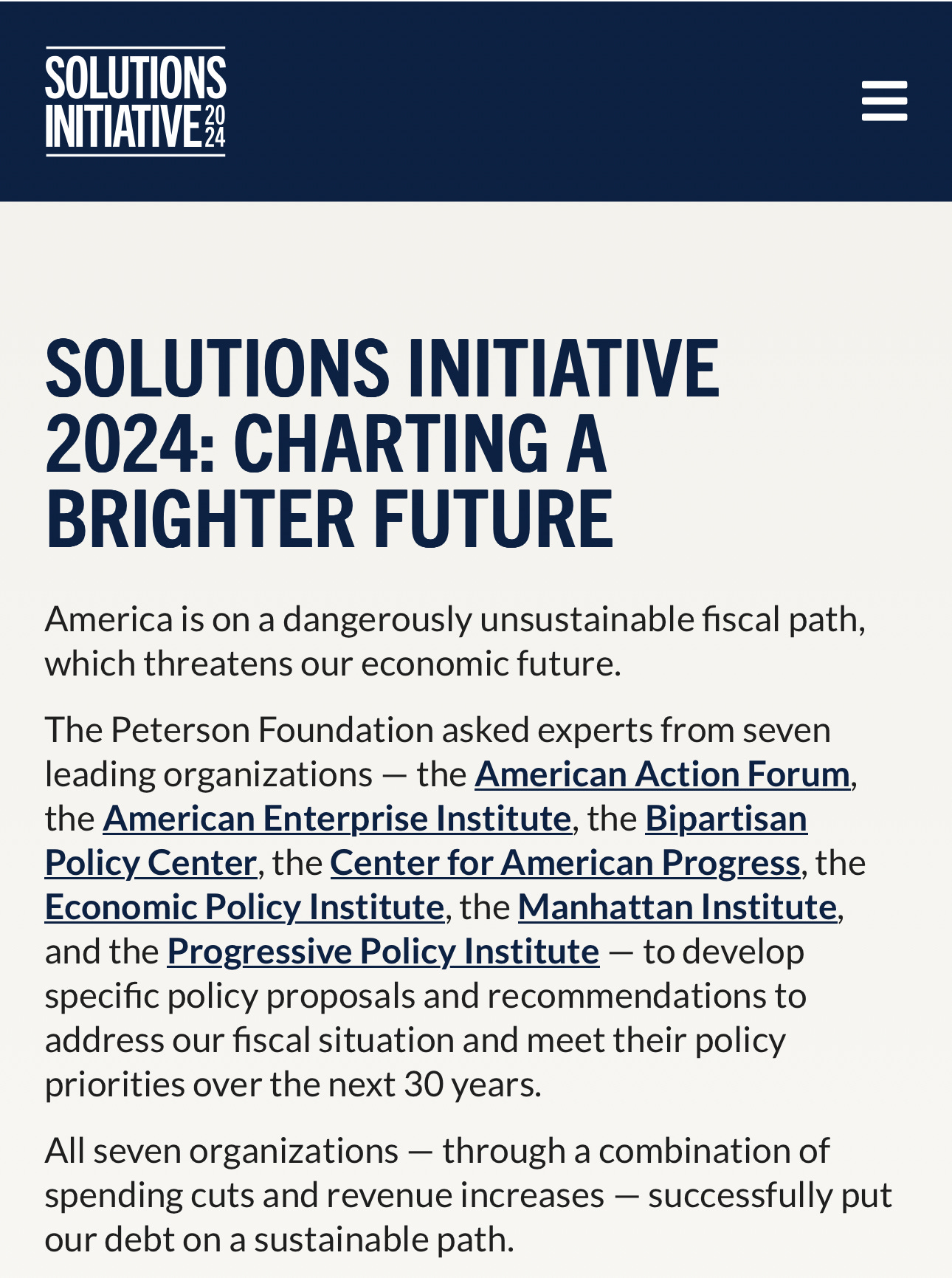
In 2024, the Peter G. Peterson Foundation did something unusual. It handed money to seven of Washington’s leading think tanks — organizations that agree on almost nothing — and asked each of them to solve the national debt. Not gesture at it. Solve it.
They called it Solutions Initiative 2024.
The American Enterprise Institute participated. So did the Economic Policy Institute. The Manhattan Institute. The Center for American Progress. The Bipartisan Policy Center. The Progressive Policy Institute. The American Action Forum.
Every single plan worked.
That is the finding worth stapling to the wall of every congressional office. Not one plan — seven. Across every ideological orientation, through combinations of spending cuts and revenue increases that varied in composition, all seven organizations produced a credible path to fiscal stability.
Where the plans agree is striking.
Every organization concluded that healthcare costs are a major driver of long-term debt and must be addressed. Every organization found some changes to Social Security and Medicare unavoidable. Every organization accepted that the gap cannot be closed on one side of the ledger alone.
Where they differ is essentially a values argument dressed in fiscal language.
The right-leaning plans arrive at a smaller government, relying more heavily on spending restraint. The left-leaning plans envision a larger government financed by significantly higher revenues. Both paths stabilize the debt.
The center lands somewhere between those poles, distributing sacrifice across both parties’ sacred cows. A little entitlement reform. A little tax reform. Something for everyone to dislike, which is the definition of a workable compromise.
The obstacle is creating the political conditions under which elected officials are willing to choose.
The Mechanisms for Action
Democracies have developed mechanisms precisely because ordinary politics fails on problems like this one. None is perfect. But they represent the available toolkit.
Bipartisan commissions are the most familiar. Their weakness, as Bowles-Simpson demonstrated, is that they require political leaders to embrace the recommendations after they are made.
A stronger version — modeled on the military base-closing process known as BRAC — would insulate fiscal recommendations from amendment entirely. Under BRAC, a commission's proposals become law automatically unless Congress votes to reject them in their entirety. Lawmakers cannot pick and choose — they can only accept or block the package whole.
Variations of this idea have been proposed repeatedly for Social Security reform, most recently the Bipartisan Social Security Commission Act of 2026, introduced by Republican Tom Cole and Democrat Tom Suozzi. None has passed.
Fiscal rules offer another approach — statutory limits on deficits, debt, or spending designed to constrain elected leaders. The United States has tried versions before. The Gramm-Rudman deficit targets of the 1980s and the budget caps of 2011 both broke down when Congress decided the limits had become more painful than the deficits.
Independent fiscal institutions offer a fourth path. The Congressional Budget Office already plays this role in part by providing nonpartisan scoring of legislation. But the United States has no institution specifically tasked with evaluating government fiscal plans against long-term sustainability targets — and holding leaders publicly accountable when they fall short. The United Kingdom's Office for Budget Responsibility does exactly that. The U.S. does not have an equivalent.
Automatic triggers may be the most technically promising approach. Under such a system, reforms would take effect automatically when a trust fund approached insolvency, unless Congress voted to stop them — flipping the default. Inaction would now produce reform rather than prevent it. Policy experts across the ideological spectrum have proposed versions of this idea.
Each aims to give elected leaders the political cover to make decisions they already know need to be made. The debt keeps rising.

What Usually Forces Action
Riedl has been direct about where the current trajectory leads. “Washington is on a totally unsustainable fiscal path,” she has written, “that virtually ensures some version of a debt crisis.” History offers a sense of what that looks like.
By the early 1990s, Canada had spent years running deficits that were producing familiar warnings: the debt was too large, the trajectory was unsustainable, something had to change.
Cabinet minister Marcel Massé would later recount one such moment when the warnings stopped being abstract. The deputy minister of finance, he wrote, "told me, ashen-faced before a cabinet meeting early in 1994, that 30 minutes before a Government of Canada bond auction that morning there had been no bids.”
In American terms, this would be the U.S. Treasury holding a routine auction for the bonds that finance the federal deficit — and finding no buyers.
Even then, action did not come quickly. Credit-rating agencies were threatening downgrades. International investors were openly questioning Canada's finances. In January 1995, The Wall Street Journal published an editorial calling Canada “an honorary member of the Third World.”
On February 27, 1995, Finance Minister Paul Martin introduced one of the most aggressive deficit-reduction plans in the country’s modern history. Federal spending was cut sharply. Revenues increased. Three years later, Canada recorded its first budget surplus in nearly three decades.
The argument had been available for years. What changed was that the cost of inaction became immediate and visible. The bond market had delivered a verdict that politicians could no longer postpone.
This is the path many fiscal experts believe is most likely for the United States. Not a grand bargain engineered by statesmen. Not a voter awakening. A market event — a spike in Treasury yields, a failed auction, a high-profile downgrade — that suddenly makes the cost of inaction greater than the cost of action.
Earlier this year, the Committee for a Responsible Federal Budget — a nonpartisan fiscal watchdog whose board includes former senators and cabinet secretaries from both parties — warned that the United States is "woefully underprepared" for the next economic shock. It called on Congress to develop what it labeled a "Break Glass Plan," ready to deploy the moment a crisis strikes.
The CRFB did not say if.
It said when.
Before the Sky Begins Falling
Which brings us back to Jessica Riedl. She has spent years warning that there is no painless path out of America’s debt problem. But there is an important distinction between painful and impossible.
In a 2024 Manhattan Institute blueprint, Riedl proposed gradually raising Social Security's early and full retirement ages to 64 and 69, trimming Social Security and Medicare benefits for higher earners while protecting lower-income seniors, and reforming Medicare through more competitive pricing. On the tax side, her blueprint would restore the top income tax rate to 39.6 percent, remove loopholes to avoid capital gains taxes, and eliminate a tax break the 2017 law created for business owners that salaried workers do not receive. No single element closes the gap. The point is the combination.
Her conclusion mirrors what emerged from the seven Peterson Foundation plans: the details differ, the values differ, the balance between taxes and spending differs — but they all converge on the same point. There is no version of stabilizing the debt that allows Americans to keep every promise, maintain current tax levels, avoid major spending reforms, and still bring the debt under control.
The solutions have been studied, scored, debated, revised, and published for years.
The challenge is political.
The cruelest consequence of delay is that the window for gradual reform keeps closing. Every conventional political promise — “we won’t touch benefits for anyone over 55” — becomes harder to honor with each passing year.
Voluntary reform — the kind Congress could enact today with gradual phase-ins, protections for vulnerable retirees, and decades for households to adjust — would almost certainly be less painful than the version imposed by a crisis. Every year of delay makes the eventual changes larger, more abrupt, and more politically explosive.
History suggests that democracies rarely act until they must. Canada waited until markets forced the issue. The United States may prove different. It may not.
The solutions are written.
The unanswered question is whether America’s elected leaders adopt one before the bond market writes its own.
Prefer to listen? I narrate each edition myself. Find the audio at the top of this page or under the Listen tab at solvingfor.io.
If you enjoyed this look at one of America's most pressing — and most deferred — problems, please give it a like and share with a friend.
Solving For takes on one pressing problem at a time: what’s broken, what’s driving it, and what a path forward might look like.
Previous series have examined rare earth dominance, AI safety, the decline of local news, the end of amateurism in college sports, shrinking competition in Congress, social media and teen mental health, and a world rearming as the global rules-based order weakens. Learn more at solvingfor.io.
This is an articulate, objective, and insightful piece (as have been the previous 2 on this topic) that deserves much wider notice (WSJ?). Real solutions are always real work and transiting the difficult cost/benefit path as you so well point out.