


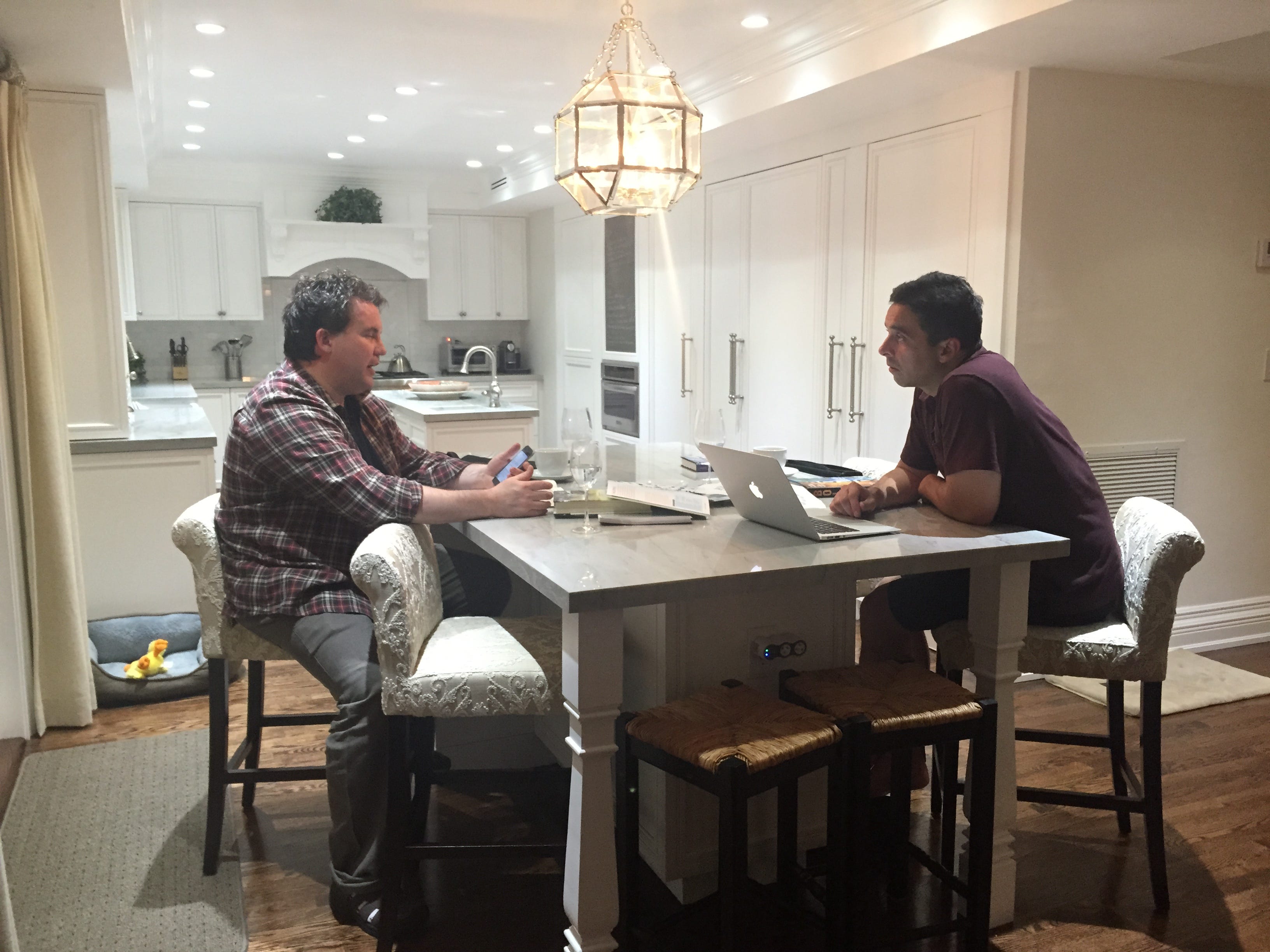
This week we return to the Open Thread, our bridge between deep-dive series for updates, experiments and essays. This one is about Peter Kellner, a dear friend and pioneer whose impact continues to ripple around the world, even as he left us much too soon.
A note for next week: I’m heading into surgery to repair a stubbornly broken collarbone. So we’ll reprise an installment of a previous series. We launch a new series on biology after that.
Solving For is for people who want to dig into hard problems and explore solutions — unpacking the stakes, examining the forces, and surfacing paths forward. We’ve published 11 series to date on topics ranging from Rare Earth Elements and Space to the American Dream. Each unfolds in three parts. You can read or listen — narrated by me — at solvingfor.io, or click the voiceover at the top of the page. Learn more.
I first met Peter Kellner in the lobby of a Miami Beach hotel in spring 2012.
I had joined Knight Foundation months earlier after a decade as a journalist. Alberto Ibargüen, Knight’s CEO, who had hired me at The Miami Herald when he was its publisher, laid out the assignment: figure out what Knight should do next in Miami.
After several months of conversations, reading, and thinking with Knight colleague Ben Wirz, I sat down with Alberto and said the future for Miami was tech and entrepreneurship. Miami’s problem was brain drain. Too many of the city’s most talented were leaving to build careers elsewhere. This was a way to change that. Alberto had questions, but said “OK” — and gave the green light for us to run as fast as we could. (I recently came across this 2013 speech I gave laying out the strategy.)
But now the challenge was making it real.
Which brought me to Peter. Our mutual friend Beau Ferrari had arranged the meeting. Sitting in an armchair in the lobby of the then-named Canyon Ranch hotel was this man brimming with energy, confidence, and possibility. I shared our vision for Miami. The primary centers of innovation weren’t going away, but new ones would emerge. Talent and capital were poised to become more distributed, in more places. Miami could be one of them.
In those early days, that argument met plenty of skepticism. Remember, this was 2012. But Peter didn’t just nod in agreement. His eyes lit up. He said he wanted to help make it happen, and told me about Endeavor, the organization he co-founded in 1997 to drive high-impact entrepreneurship in emerging markets. Endeavor wasn’t operating in the U.S. We resolved that day to make Miami its first U.S. city.
Endeavor Miami launched in 2013, and it continues today.
It also became the tentpole of our Knight Foundation work to establish the startup ecosystem we imagined. Over the next two years, this included funding the launch of the annual tech conference, eMerge Americas; The Idea Center at Miami Dade College for education; Miami Angels for investment; and The LAB Miami on NW 26th Street for co-working, when there was virtually none in Miami. All continue today. There were many, many other investments too.
We even did an informal poll asking where Miami’s emerging tech scene should take root, though we already knew our answer: Wynwood. When Endeavor Miami kicked off with Peter, it was at The LAB Miami in Wynwood.
But what mattered most was the statement of belief. At a time when few saw Miami as a future center of innovation, Peter did. And by bringing Endeavor here, he made that belief tangible.
It can sometimes seem like things were always meant to happen a particular way. But that’s rarely true. Things happen because of decisions made, by people who see what needs to be done, act, follow through, and stick with it even when few care or notice.
Not riding a wave, but helping start one. That was Peter, so early to the scene that many today don’t know he was even there.
I’ve thought about that first encounter often over the years, and never more than now. On Oct. 3, we gathered at Madison Avenue Presbyterian Church in Manhattan to honor and say goodbye to Peter, who died suddenly in July at just 56. His family, in their memorial tribute, called him “bottled lightning.”
THE COURAGE TO GO WHERE OTHERS DIDN’T
Peter could have done anything. He had degrees from Princeton, Yale Law School, and Harvard Business School. But he had the courage to go to the overlooked places, and the conviction to go all-in when he got there.
He co-founded Endeavor with Linda Rottenberg in 1997 while at Yale Law School, taking time away to spend months in Chile to build the first country office. The premise was that entrepreneurs, given the tools and support to do big things, could change lives and transform economies. Today Endeavor operates in more than 50 countries. Its entrepreneurs have built more than 100 companies valued at $1 billion or more.
While serving as a Fulbright Scholar in Hungary, Peter co-founded an environmental law organization, EMLA, as the country was emerging from communism. Modeled after the Natural Resources Defense Council, it’s still operating more than 30 years later.
He provided early funding for the first nonprofit of his law school classmate Stacey Abrams, who would later found Fair Count. He supported LIFT’s work fighting poverty and mentored its co-founder, Brian Kreiter. He was also an early investor in companies including Salesforce, Compass, Toast, and Rubicon.
And he supported efforts few ever knew about.
At the celebration of life following the church service, David Frazee, Peter’s longtime friend and investment partner, shared a message that Peter’s wife, Meredith, had received from someone in Hungary. In the 1990s, Peter had helped start a literary magazine for young writers locked out of the Hungarian publishing world.
Many went on to become celebrated authors thanks to Peter’s support, the person wrote, adding: “I’m not even sure that Peter himself knew.”
In all their years together, Frazee said, Peter had never mentioned it. There were many other stories like that.
Peter aimed his mix of talents at one thing: unlocking human potential around the world. And he did it with good humor, exuberance, a hearty laugh, and a warmth that filled any room he entered.
BEARING WITNESS
I saw all of these qualities firsthand in Miami.
When some questioned the vision, he believed.
When Endeavor Global’s board pushed back on launching a U.S. office, he went all in. (Fernando Fabre, Endeavor’s then-president, did too.)
I vividly remember sitting in my Knight office waiting for word that the Endeavor board, meeting in New York, had approved the expansion. I finally couldn’t wait any longer and emailed Peter and Fernando: “How did things go?” Peter’s reply was short: “All set. We’re good.”
For me, it was especially meaningful. At Knight, grants of a certain size must go before the foundation’s trustees for approval. The grant to launch Endeavor Miami was the first I took to the trustees. As it happened, that grant would become the subject of a Harvard Business School case study.
But the work was far from done. And Peter was there every step of the way.
We needed to build a Miami board. Endeavor Global’s Joanna Harries, Peter, and I would discuss potential members. I received a call that Adriana Cisneros was moving to Miami. We pursued her. Peter joined a meeting with her in New York, asking her to be the Endeavor Miami board chair. Once again, I waited by the phone. He and Joanna called to say Adriana was in. She and Daniel Echavarria would be the founding co-chairs of Endeavor Miami.
Endeavor required the Miami board to commit $3 million over five years. Forming a board typically took Endeavor about a year. In Miami, it took three months.
Then we had to build the team. Peter was there when Laura Maydon was selected as the founding managing director. Laura would later recount how Peter helped her set up the office and recruit entrepreneurs, including Roger Duarte, who, tragically, died this summer in a helicopter crash on safari in Kenya.
One afternoon we organized a roundtable in the Knight Foundation boardroom with Peter and a group of entrepreneurs. With his résumé, Peter could have spent hours reciting what he’d built. He didn’t mention any of it. Instead he said, “Let’s talk about failure.” And he talked about hard times and how you get through them.
That was Peter.
RABBIT HOLES AND REAPPEARANCES
Rev. Frank Strasburger, Peter’s chaplain at Princeton, who later married Peter and Meredith, spoke at the service. He called Peter a juggernaut for good, a trailblazer who was sometimes a bulldozer, always laser-focused on building up this broken world of ours.
But, he added, Peter “did have his rabbit holes.” Moments when Peter and the rest of us lost track of each other. Those were times, Rev. Strasburger said, when Peter’s “own confidence seemed to flag.”
I experienced this. After Endeavor Miami had been set up with an all-star board and managing director, Peter attended the first board meetings, then gradually stepped away as it became clear things were in good hands. He continued Endeavor’s expansion in the U.S., launching in Louisville. Detroit would come too.
Peter set things up with his intense focus and vision, and then stepped aside for others to be celebrated.
Meanwhile, Peter was a generous friend, constantly making introductions from his extraordinary network. You would tell him where you were, and he would suddenly offer up someone for you to meet. Because of Peter, I found myself having coffee with a U.S. special forces officer in Miami, having lunch with an investor from Jordan while in Istanbul, sitting down with an entrepreneur from China when we were both attending Singularity University in Silicon Valley, and joining a dinner with the King of Spain in Madrid.
Even when he stepped away, he would always reappear.
When I became so troubled by our politics that I left Knight Foundation to run for Congress, Peter was there with all his energy. He donated the maximum and organized family members to do the same. When the race took an unexpected turn, no one was more supportive about what came next.
More recently, when I returned to journalism, it wasn’t long before I noticed a new paid subscriber to Solving For at the highest tier. Then gift subscriptions for others. Of course, it was Peter. No announcement. He just appeared.
This summer I wrote several follow-ups to a deep dive I had done on AI safety. Peter emailed in the middle of the night: We need to talk. I’ve got a great AI safety idea. I wrote back asking when would be a good time. I made a note to call him.
We never connected. Days later, he was gone.
“Call Peter” is still on my to-do list.
CARRYING HIS LIGHT FORWARD
At the packed church service, Rev. Strasburger called Peter a “meteor of a man.”
He recalled seeing a meteor burst across the sky when he was a young boy. Shooting stars burn themselves up in the atmosphere, he said, yet 75 years later he can still see that one clearly. Peter, he said, still shines the same way.
What struck me most was how many of us in that room had our lives changed by Peter: by his kindness, his willingness to say yes, and his way of seeing what others didn’t.
I was in Mexico City last weekend, which brought me back to November 2012, when Alberto said I should see Endeavor firsthand before trustees considered our grant. Endeavor Mexico’s then-managing director, Pilar Aguilar, introduced me to entrepreneurs and investors. I remember flying home and emailing Peter that this was going to be awesome in Miami.
More than a decade ago, Peter helped set in motion what we’re seeing take shape in Miami today. We established the vision, laid the foundation for the entrepreneurial ecosystem, and built a community of believers to carry the work forward.
Later came the wave of people who moved to Miami during COVID. And on Sept. 30, Carnegie Mellon University announced a $3 billion gift from Ken Griffin, $2 billion of it to build a campus in Wynwood — two blocks from The LAB Miami, where Endeavor Miami held its first board meeting with Peter in 2013.
Back then, we were asking people to imagine what Miami could become. Today, that future is becoming a reality.
My life changed that afternoon in a hotel lobby in Miami Beach, the first time we met. Peter leaves an extraordinary legacy, and above all an army of people who will carry his light forward. I’m grateful to be one of them.
Prefer to listen? I narrate each edition myself. Scroll up to find the audio version at the top of this page.
CHECK OUT PREVIOUS SERIES: